Giovanni Battista Lusieri
Giovanni Battista Lusieri (1755–1821) was a highly skilled Italian landscape painter and draftsman whose career provides a fascinating index to the shifting cultural and political currents of the late 18th century. Known for his meticulous topographical studies and classical compositions, Lusieri began his professional life in his native Naples, where he secured the prestigious position of court painter to Ferdinand I of the Two Sicilies. This early period established his reputation for precise draftsmanship and the evocative rendering of Mediterranean light.
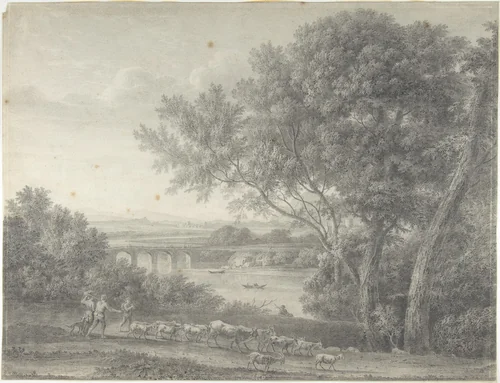
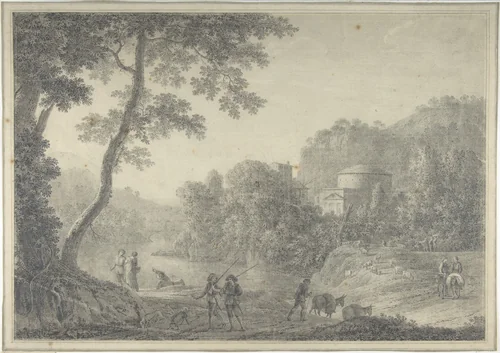
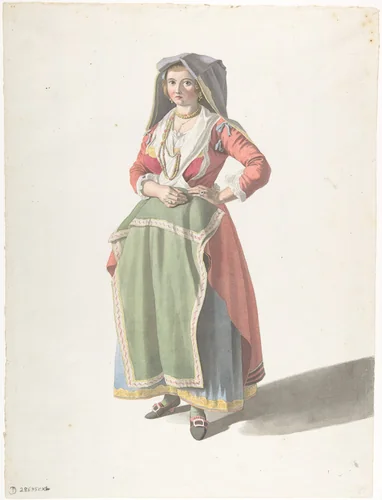
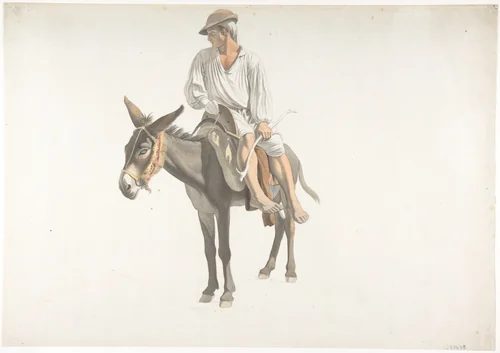
Lusieri excelled in vedute and genre scenes, fusing the idealized Neoclassical tradition with the observational accuracy demanded by patrons undertaking the Grand Tour. His finished drawings, often executed in sophisticated combinations of pencil, pen, and watercolor, documented both enduring classical architecture and contemporary life, as seen in works like Young Woman Standing in Traditional Neapolitan Dress and the finely detailed Classical Landscape with Hunters in the Foreground. His surviving corpus, held in major institutions including the National Gallery of Art and the Metropolitan Museum of Art, illustrates a commitment to clarity and rigorous compositional balance, defining his museum-quality contribution to landscape art.
The painter’s subsequent move to Athens marked a dramatic shift from the luxurious refinement of the Neapolitan court to the dusty, politically charged world of archaeological management. Lusieri transitioned from artist to agent, working for Thomas Bruce, 7th Earl of Elgin. In this capacity, he oversaw the detailed documentation and subsequent removal of the Parthenon sculptures from the Acropolis, a monumental undertaking that forever linked his name with the celebrated artifacts now known as the Elgin Marbles. This administrative pivot, from composing tranquil views to managing one of the largest art transports of the era, underscores a pragmatic flexibility seldom documented in the biographies of his contemporaries.
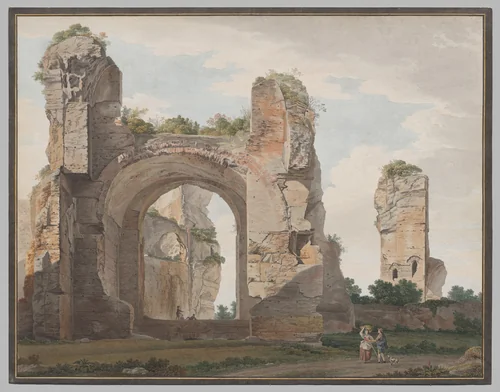
Lusieri’s works, particularly his finished studies of ruins, remain crucial historical documents. The precision required for his topographical projects ensured his drawings, such as A View of the Ruins of the Baths of Caracalla, serve as invaluable records of antiquity. While his original Giovanni Battista Lusieri paintings are rare, the enduring quality of his draftsmanship means that high-quality prints derived from his era, including much of the foundational landscape work of the late 18th century, are now widely available in the public domain.
Source: Wikipedia · CC BY-SA 4.0