Giovanni Baronzio
Giovanni Baronzio, also known by the appellation Giovanni da Rimini, represents the most eminent figure of the second generation of painters working within the influential school of Rimini. Active throughout Romagna and the Marche region during the second quarter of the 14th century (c. 1325-1344), Baronzio’s historical significance rests upon his successful assimilation and regional propagation of the formal innovations introduced to Rimini by Giotto. Giotto’s presence in the city, though brief, created a foundational rupture with prevailing Byzantine conventions, establishing a trajectory toward greater naturalism, volumetric modeling, and spatial coherence. Baronzio became the crucial interpreter and diffuser of this new visual vocabulary.
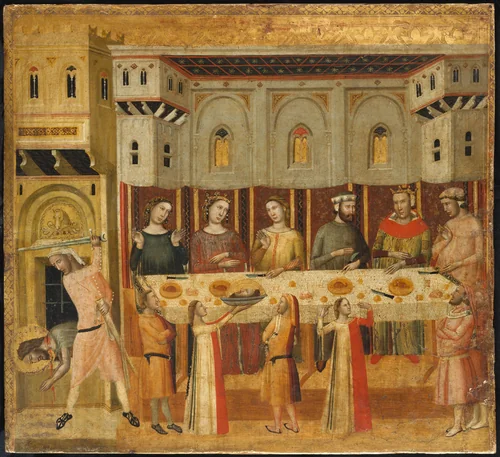
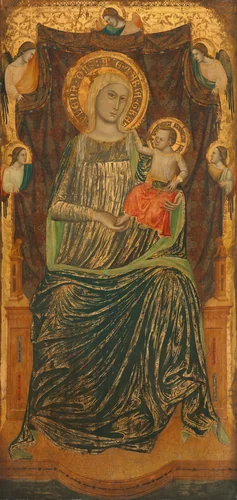
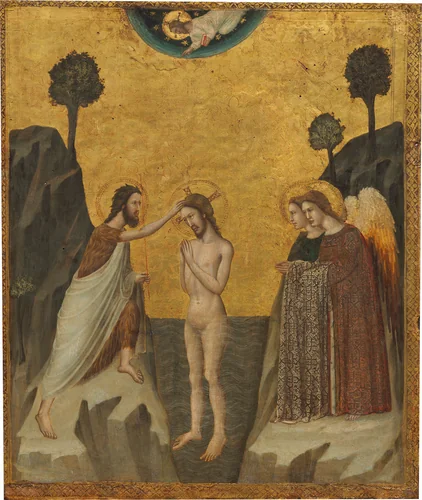
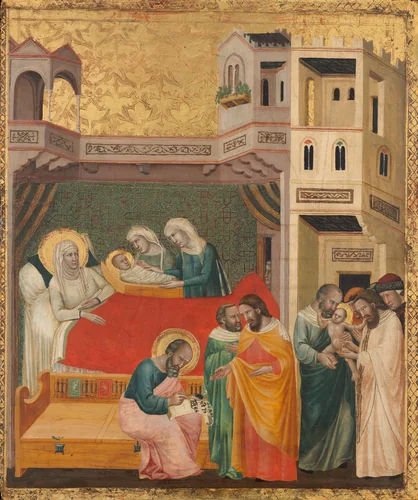
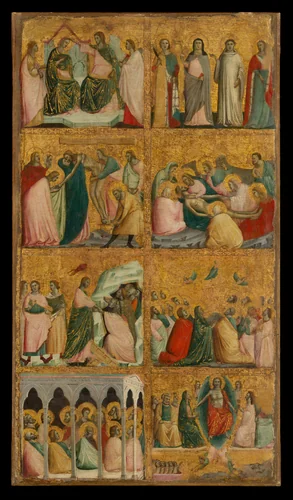
Baronzio’s surviving catalog is focused and highly specialized, dedicated almost entirely to complex devotional panels and multi-episodic narrative cycles. His extant work demonstrates a sophisticated, often densely layered storytelling style, perfect for predella panels where multiple stages of a life must be encapsulated within a single frame. Masterworks such as The Feast of Herod and the Beheading of the Baptist and the expansive The Birth, Naming, and Circumcision of Saint John the Baptist reveal his mastery of dramatic composition, achieved through sharp color contrasts and precise linear definition. While retaining some of the exquisite gilding associated with earlier medieval traditions, his rendering of figures in panels like Madonna and Child with Five Angels shows a distinct assimilation of central Italian grace overlaid onto the monumental forms inherited from Giotto. One subtle observation remains: studying the complex organization within his narrative cycles, particularly the fragments of Scenes from the Life of Christ, one appreciates the sheer logistical feat required to compress the history of salvation into such visually coherent spaces.
Despite the limited documentation regarding his personal history, the output of Baronzio’s workshop was instrumental in ensuring that the visual reforms of the early Trecento took lasting root across central Italy. Today, this vital catalog of Giovanni Baronzio paintings serves as a crucial marker for understanding the regional diffusion of post-Giotto realism. Works that once served specific regional patrons are now held in major international institutions, including the Metropolitan Museum of Art and the National Gallery of Art. Scholars and enthusiasts seeking access to high-quality prints and archival imagery benefit from the fact that many Trecento artworks, by virtue of their age, reside in the public domain, making important historical downloadable artwork widely accessible for study and appreciation. Baronzio remains a foundational figure, proving that artistic eminence is measured not merely by volume, but by the lasting authority of one's visual conviction.
Source: Wikipedia · CC BY-SA 4.0