Giovanni Angelo Canini
Giovanni Angelo Canini (1609-1666) was a key Italian artist active during the height of the Baroque period, distinguished for his proficiency as both a painter and, perhaps more enduringly, as a master engraver. Operating primarily in Rome, Canini bridged the dramatic intensity of the early Baroque with a deep-seated respect for classical composition, a synthesis evident in the precise execution and academic rigor of his surviving graphic works.
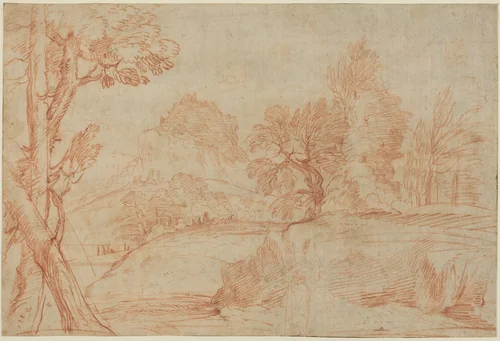
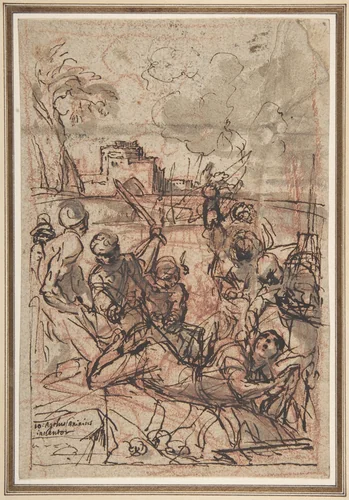
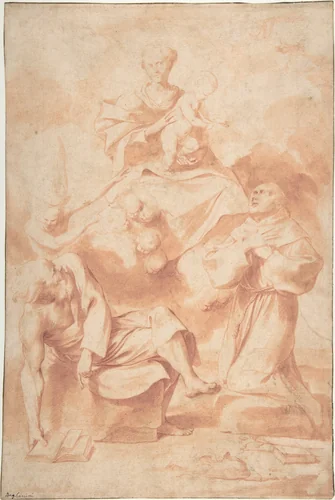
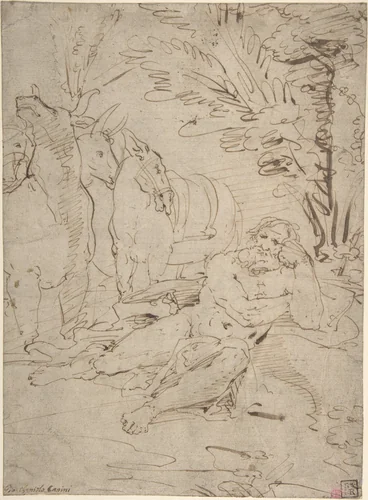
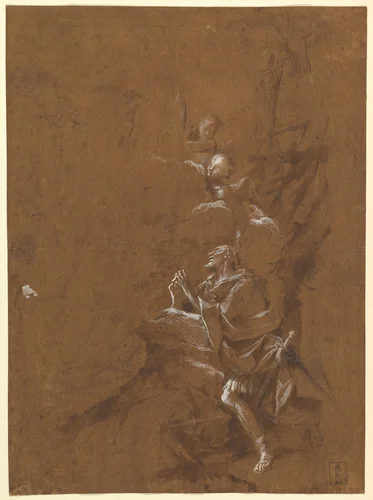
His creative output was remarkably versatile, moving seamlessly between devotional narrative and idealized classical studies. Drawings such as The Virgin and Child Appearing to Saint Anthony of Padua and a Hermit exemplify his religious commissions, rendered with the controlled theatricality typical of the mid-seventeenth century. Simultaneously, his foundational academic work, visible in studies like Unidentified Subject: Reclining Nude Male Figure and Cattle, demonstrates his unwavering dedication to the study of the human form and the idealized relationship between figure and environment, a principle further reinforced by his evocative rendering of a Classical Landscape.
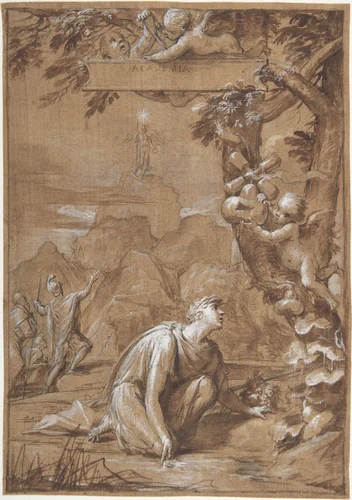
Canini was fundamentally a working artist of his era, skilled in producing functional, yet highly aesthetic, material. His design prowess is clearly seen in works such as the detailed Design for a Frontispiece; Allegorical Composition with a Young Man Kneeling before a Tree, confirming his importance within the contemporary publishing sphere where engravings served to frame and introduce major intellectual texts. It speaks volumes that, unlike many artists primarily focused on canvas, Canini’s practice was consistently concerned with reproducibility and distribution, ensuring his stylistic influence spread widely across the European graphic network.
Today, Canini’s legacy is preserved not just in rare Giovanni Angelo Canini paintings, but in highly valued preparatory drawings held in prestigious institutions worldwide, including the National Gallery of Art, the Metropolitan Museum of Art, and the Art Institute of Chicago. The detailed nature and sheer volume of his graphic output means that much of his material, including numerous high-quality prints and studies, now resides in the public domain. This continued accessibility allows scholars and enthusiasts alike to study the development of Baroque draftsmanship through easily downloadable artwork, confirming Canini's quiet but essential contribution to the age of exuberance.
Source: Wikipedia · CC BY-SA 4.0