Giacomo Rossetti
Giacomo Rossetti is a crucial, if somewhat elusive, figure whose career trajectory charts the shifting priorities of late 19th-century Italian visual culture. His significance lies not only in his individual output but in his early embrace of technological modernity, transitioning smoothly from the academic studio to the developing field of documentary photography.
Initially trained in the rigorous academic tradition at the prestigious Academy Carrara di Bergamo, Rossetti first achieved widespread recognition as a painter. His early professional ascent was sealed following the production of a now-celebrated portrait of Giuseppe Garibaldi, positioning him directly within the prominent historical narrative of the newly unified Italian state.
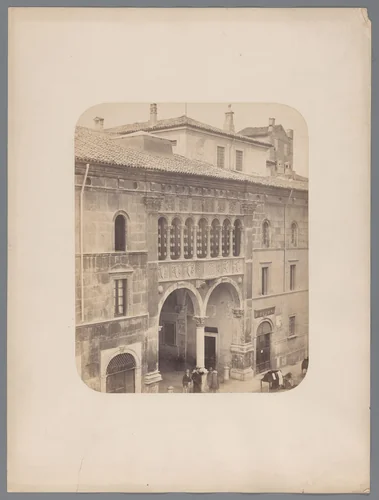
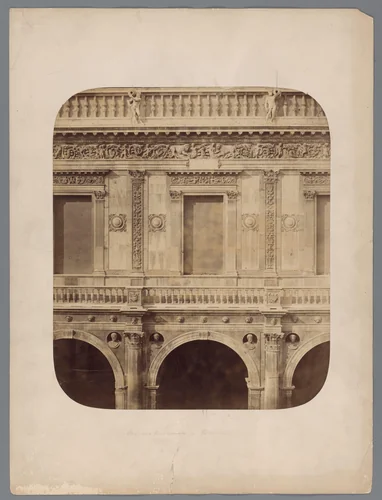
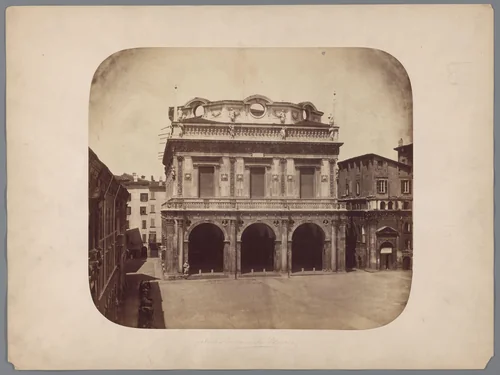
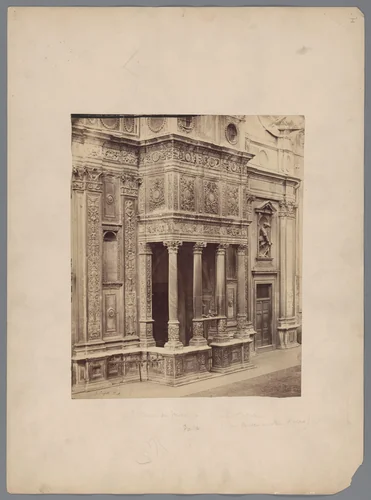
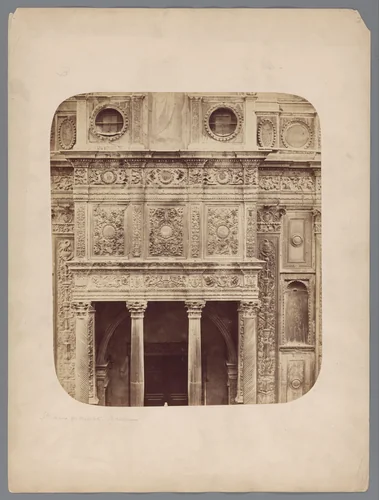
However, Rossetti dedicated the latter phase of his professional life not to the canvas, but to the challenging technology of the camera. This pivot saw him transition from interpretive portraiture to meticulous architectural documentation, a characteristic move among artists seeking new forms of objective representation during the 1870s. Operating actively between 1870 and 1873, his extant photographic corpus focuses heavily on the historical structures of Brescia. Images such as Palazzo Communale in Brescia and Santa Maria dei Miracoli, Brescia illustrate his highly refined interest in volume, texture, and light, often capturing architectural surfaces with an almost tactile precision.
Although he began by producing important Giacomo Rossetti paintings, his lasting legacy rests on these photographic works. The sheer commitment required to adopt and master early photographic processes suggests an artist driven more by technical curiosity than by simple stylistic preference; his true passion appears rooted in process itself.
Rossetti’s output from this brief but intense photographic period provides invaluable early documentary evidence of Italian civic and ecclesiastical architecture before the changes brought by the 20th century. Because these rare images are held in major collections, such as the Rijksmuseum, they are increasingly entering the public domain. This ensures that the historical record Rossetti captured is widely available, often informing contemporary scholarship. Today, these works are readily accessible as museum-quality images, available as high-quality prints for study and collection.
Source: Wikipedia · CC BY-SA 4.0