Gherardo Cibo
Gherardo Cibo (1512-1570), also known by the alias Ulisse Severini da Cingoli, occupies a unique and significant dual position in the Italian Renaissance, operating at the critical intersection of natural science and visual draftsmanship. While recognized in his time as a pivotal herbalist, Cibo’s surviving oeuvre of eight precise drawings confirms his status as a sophisticated early master whose work presaged the development of pure landscape art.
Cibo’s artistic method was profoundly influenced by his commitment to scientific rigor. In 1532, he began compiling a comprehensive herbarium, a meticulous project that represents the oldest surviving example of the systematic method of plant preservation invented by his Italian contemporaries. This commitment to empirical observation translated directly into his visual art, distinguishing his work from purely theoretical or imaginative studies.
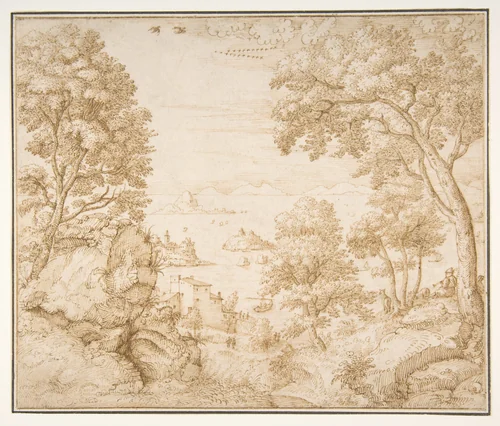
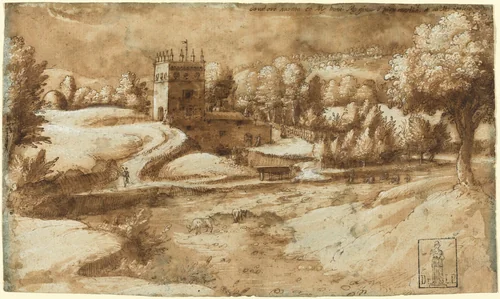
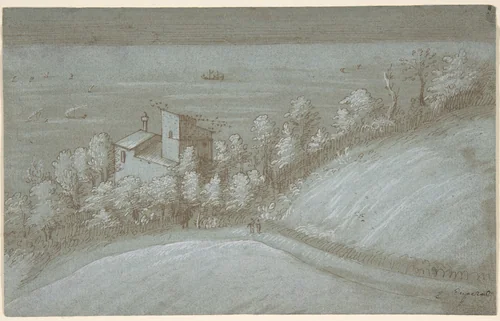
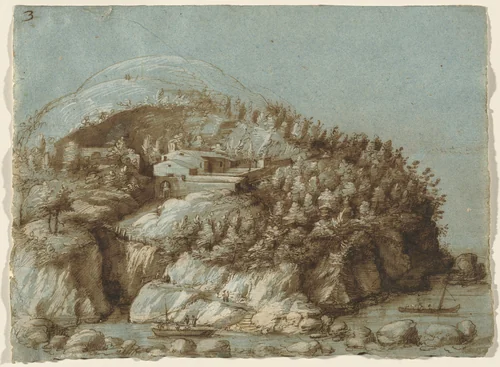
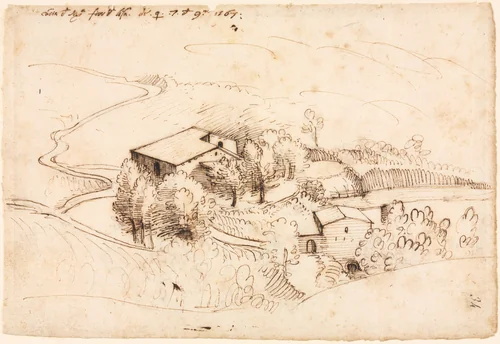
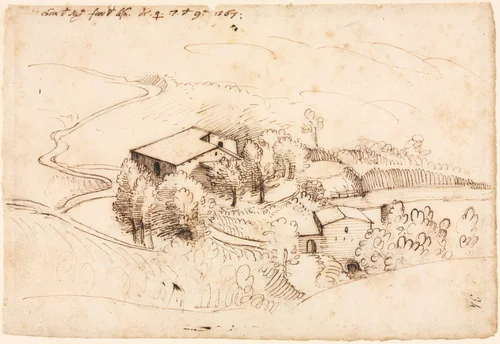
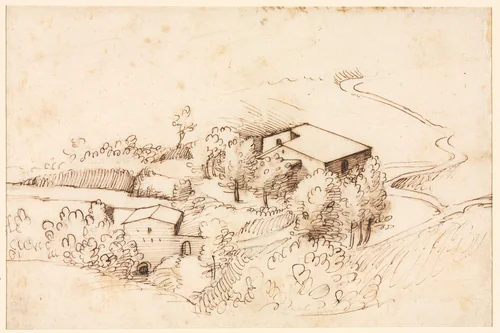
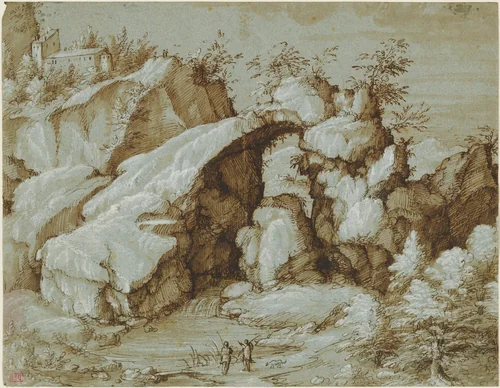
Unlike traditional artistic backgrounds that served merely as stage dressing, Cibo’s drawings integrated highly detailed botanical illustrations in the foreground with expansive, topographically specific landscapes, often detailing human activity and architecture. Works like A House with a Dovecote and Trees by the Sea and Hilly Landscape with Ships utilize a measured perspective that captures both the minutiae of local vegetation and the broad atmospheric effects of the central Italian terrain. This fusion of disciplines ensured that the background details were rendered with the same observational precision applied to the flora.
His drawings, which include titles such as Coastal Landscape and View near Rosora di Serra San Quirico, are now rare treasures held in prestigious international collections, including the Metropolitan Museum of Art and the National Gallery of Art. They provide an invaluable record of 16th-century Italian topography and compositional practice. It is perhaps this dedication to both micro and macro reality that gives Cibo’s scenes an enduring sense of quiet authority, suggesting that for this artist, the natural world was less a stage for human drama and more a perfectly ordered curiosity.
Today, this small but highly influential body of work is preserved digitally. Due to their historical age, these works reside in the public domain, allowing contemporary audiences access to museum-quality reproductions. The enduring appeal of Gherardo Cibo prints ensures that his unique contribution to the history of landscape drawing continues to inform and inspire.
Source: Wikipedia · CC BY-SA 4.0