Gerrit Rietveld
Gerrit Rietveld (1888-1964) stands as a foundational figure in 20th-century functionalism, mastering the twin disciplines of Dutch furniture design and architecture. His significance lies in his rigorous methodology: the systematic reduction of complex objects into their most elementary geometric components, a principle that revolutionized the relationship between form, color, and space.
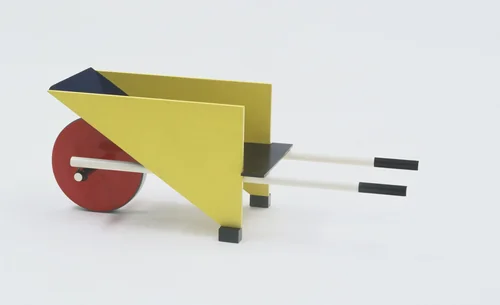
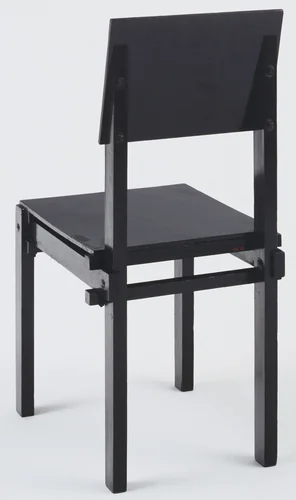
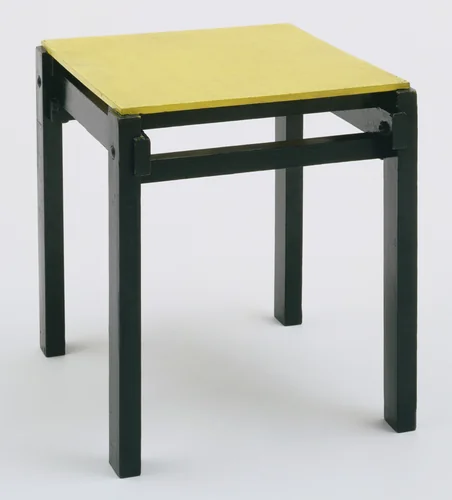
The period between 1918 and 1924 proved pivotal, establishing the aesthetic vocabulary that defines his career. His designs are radical manifestos in primary colors and orthogonal structures. The Red Blue Chair, perhaps his most widely recognized creation, is less a conventional seat than a three-dimensional study of line and plane, eschewing traditional upholstery entirely to reveal the underlying structural integrity. This dedication to elemental geometry extended across his catalog of domestic utility, from the stark Military Side Chair and the simple Stool to the more surprisingly charming Child's Wheelbarrow.
Rietveld translated this planar philosophy into architecture with his most famous project, the Schröder House in Utrecht (1924). This residence functions as a kinetic exploration of space, utilizing sliding walls and open floor plans to challenge static notions of domesticity. The resulting structure, often studied through models like the 1:20 scale representation held in major collections, is recognized internationally as a monument to functionalist idealism.
Rietveld's work, collected by institutions worldwide including the Museum of Modern Art, established a benchmark for modern design clarity. His legacy ensures that his technical innovations and structural studies remain critical subjects for historians and artists, guaranteeing sustained demand for museum-quality reproductions. Today, the foundational drawings and studies underpinning his designs, which have largely entered the public domain, are frequently sought after for high-quality prints, sustaining the global influence of the Dutch master’s clear, uncompromising vision.
Source: Wikipedia · CC BY-SA 4.0