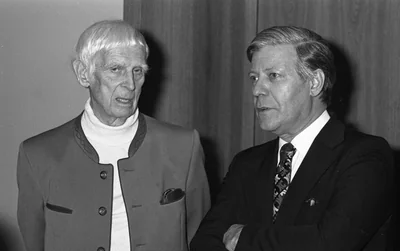
Gerhard Marcks
Gerhard Marcks (1889-1981) holds a singular place among the masters of twentieth-century German art. Primarily known as a sculptor whose work defined post-war figuration, Marcks was equally fluent across drawing, ceramics, lithography, and the woodcut. This multidisciplinary approach positioned him as an influential figure during the interwar years, particularly through his pivotal association with the early State Bauhaus in Weimar.
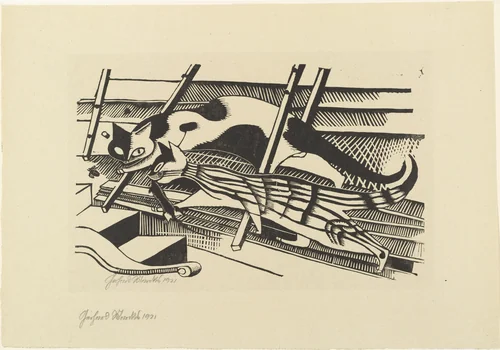
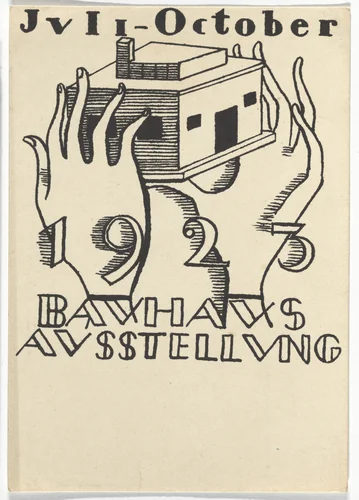
During the institution’s formative period, Marcks served as a Formmeister and contributed significantly to its graphic initiatives. His graphic works from 1921 to 1924, characterized by concise line work and profound empathy for his subjects, demonstrate a deep commitment to translating sculptural mass into two dimensions. He was represented in the seminal 1921 collection, Neue europäische Graphik, 1. Mappe: Meister des Staatlichen Bauhauses in Weimar, which included dynamic studies such as Cats (Die Katzen) and The Owl (Die Eule). His commitment to the school’s public image is further evidenced by his design for the Bauhaus Ausstellung Weimar Juli - October 1923 poster.
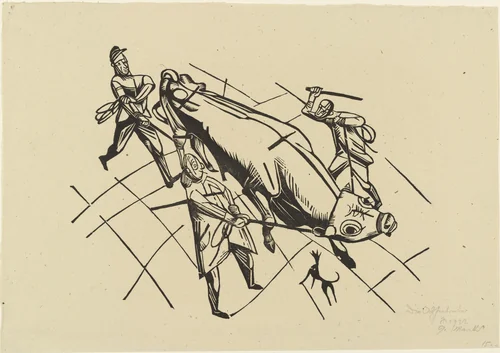
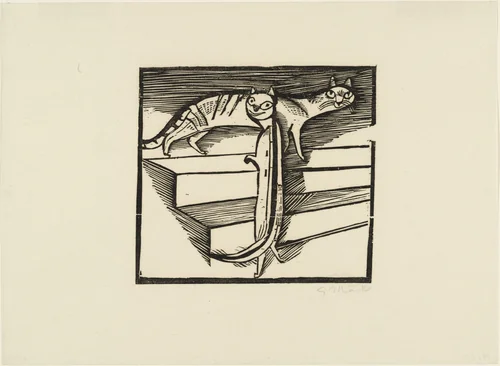
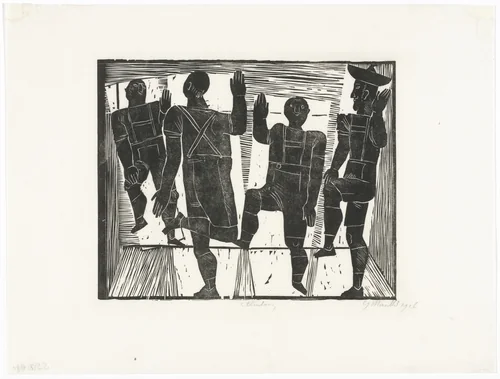
Marcks possessed an enduring and often understated fascination with the creature world, viewing animals not merely as subject matter but as essential conduits for expressing elemental form and movement. Pieces like Ox Drivers (Ochsentreiber) capture the weighty effort of labor, while studies such as Little Cats (Die kleinen Katzen) reveal an observation that is both affectionate and rigorously formal. This consistent exploration of animals, whether domestic or pastoral, lends a quiet humanism to his oeuvre.
Although his monumental sculpture secured his lasting renown, Marcks’s graphic output from the Weimar era confirms his status as a masterful printmaker. These foundational Gerhard Marcks prints, collected by major institutions including the Museum of Modern Art, offer direct insight into the crucial transition period of German Modernism. Today, the high-quality prints derived from many of his early images, now in the public domain, ensure that these powerful, expressive works remain accessible worldwide for appreciation and study.
Source: Wikipedia · CC BY-SA 4.0