George Vertue
George Vertue (1684-1756) holds a dual and essential place in the history of British art: he was both a prolific and skilled master of the engraving medium and the period’s most crucial historian. As an English engraver and meticulous antiquary, Vertue’s technical output, primarily through line and stipple work, served to document and disseminate the visual culture of the first half of the eighteenth century across Britain and Europe.
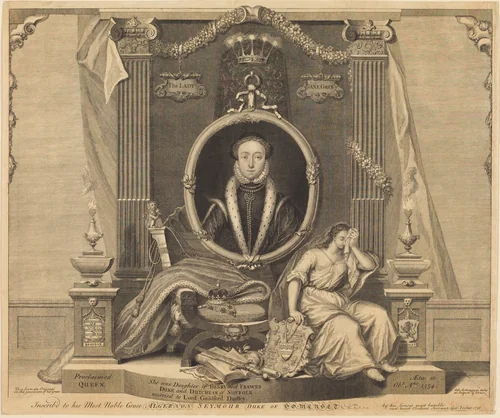
Vertue specialized in reproductive prints, acting as the primary conduit for circulating images of significant historical portraits, architectural achievements, and celebrated monuments. His œuvre includes detailed and authoritative depictions of historical figures such as Francis Bacon and Mary, Queen of Scots, often derived from paintings held in private collections. His exacting approach also generated essential topographical and architectural documentation, exemplified by the view of the Shakespeare Monument in Church at Stratford-on-Avon. This painstaking work allowed him to create high-quality prints that established visual records of cultural artifacts, preserving them for future generations.
While his engravings demonstrated craftsmanship in their own right, Vertue’s enduring and arguably more significant contribution lies in his prodigious literary output—specifically, the exhaustive collection of notebooks he maintained throughout his working life. These journals contain invaluable, first-hand accounts of artists, patrons, collectors, and the general mechanics of the art market during the Georgian era. It is here that Vertue transcends the role of mere printmaker to become the period’s indispensable, if occasionally judgmental, historical authority. His meticulous records provide a critical, primary resource for art historians that remains unmatched by other sources of the time.
Vertue’s influence is confirmed by the sustained interest in his works, which are housed in premier institutions globally, including the Metropolitan Museum of Art, the National Gallery of Art, and the Art Institute of Chicago. Given that many of his plates served as early publishing illustrations, the collection of George Vertue prints constitutes a key portion of the historical visual archive. Today, the images derived from his work are often available as public domain resources, ensuring that this irreplaceable record of eighteenth-century culture remains widely accessible.
Source: Wikipedia · CC BY-SA 4.0