Geo Poggenbeek
George Jan Hendrik Poggenbeek (1853–1903) was an accomplished Dutch painter whose career spanned the defining period of tonal realism in the Netherlands. Operating primarily from Amsterdam, Poggenbeek maintained close professional contact with leading exponents of the Hague School, embracing their commitment to nuanced color, atmospheric rendering, and the quiet dignity of the traditional Dutch landscape. He swiftly established a reputation for painting and drawing intimate, domestic scenes that prioritized mood over narrative.
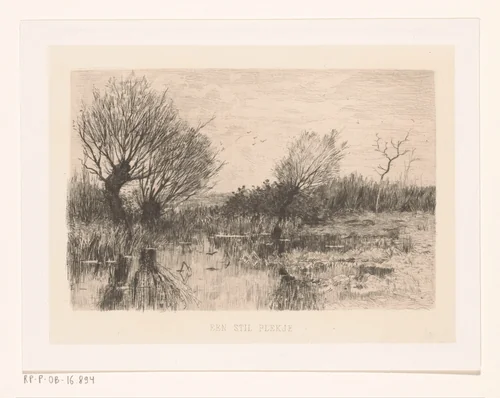
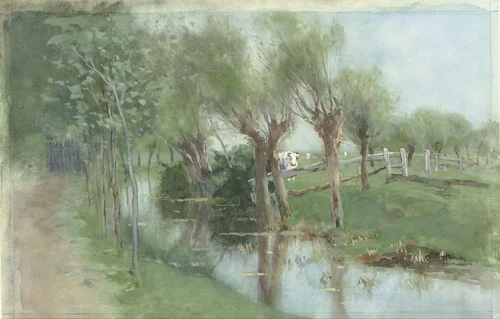
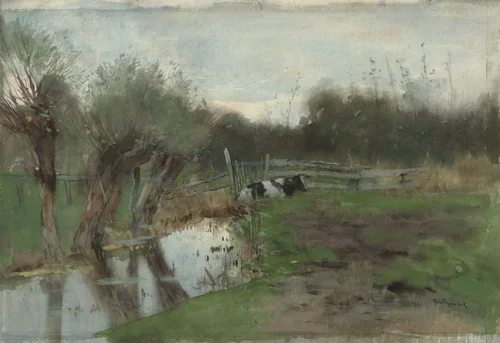
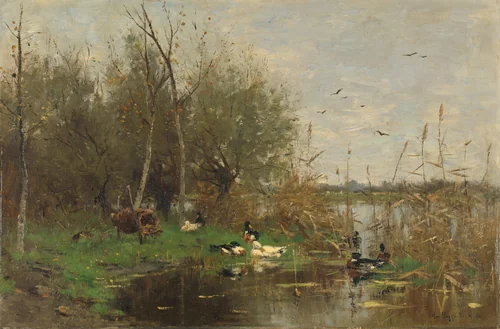
Poggenbeek worked across various media, leaving behind a carefully curated oeuvre of paintings, drawings, and limited edition prints. His subjects were consistently drawn from the rural polders, focusing on the interplay of water, light, and characteristic flora. Works such as Een stil plekje and Ducks beside a duck shelter on a ditch exemplify his precision in observing daily life along the canals and ditches. He was particularly skilled at rendering the specific texture and melancholy form of the knotwilge, or pollarded willow, a tree that often functions as a visual anchor in his compositions, notably the quick, effective study Knotwilgen aan een sloot.
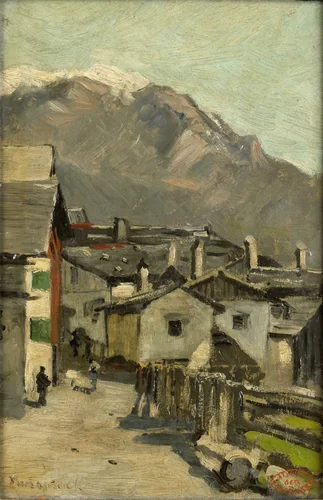
The enduring quality of Poggenbeek’s draftsmanship secured him a place in prestigious collections, including the Rijksmuseum. While much of his work concentrated on the flat, water-bound horizons of the Low Countries, the existence of pieces like the detailed drawing Houses along a road near a mountain (Innsbruck?) suggests that he occasionally sought inspiration in more dramatic, mountainous scenery, providing a glimpse of the artist’s travels beyond his familiar surroundings.
Poggenbeek’s output demonstrates the technical rigor expected of this generation of landscape specialists. Today, the clarity and technical excellence of many Geo Poggenbeek paintings and prints ensure their continued scholarly relevance. A significant portion of the artist’s creative output has passed into the public domain, providing researchers and art lovers alike with access to high-quality prints and downloadable artwork that solidify his position among the late nineteenth-century masters.
Source: Wikipedia · CC BY-SA 4.0