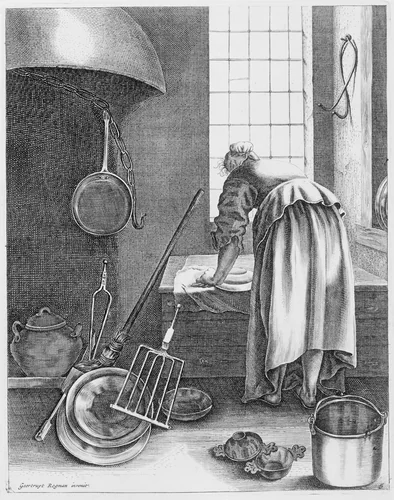
Geertruydt Roghman
Geertruydt Roghman (active 1635-1643) was a compelling figure in the history of Dutch graphic arts, operating simultaneously as a painter, engraver, and printmaker during the highly competitive period of the Golden Age. While historical documentation regarding her life remains fragmentary, the surviving body of her print work establishes her as a sophisticated genre specialist and one of the rare female engravers of her era. Her artistic contributions are notable for their unwavering focus on the prosaic activities of women within the domestic sphere.
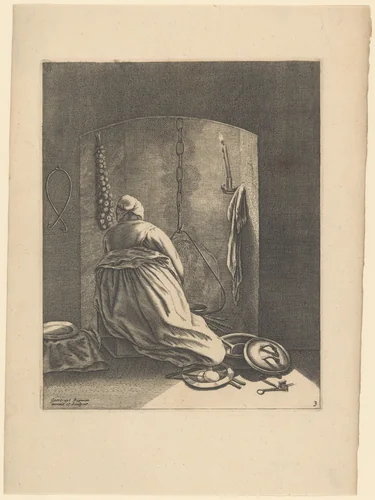
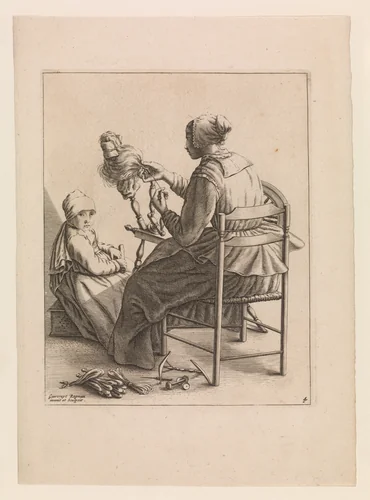
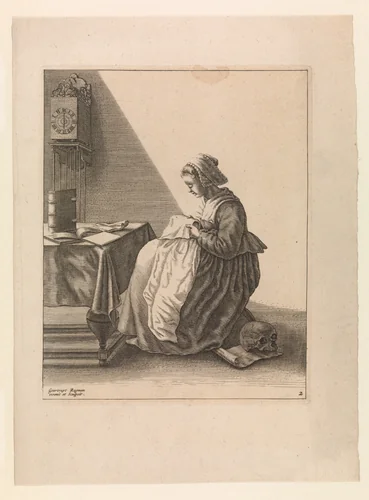
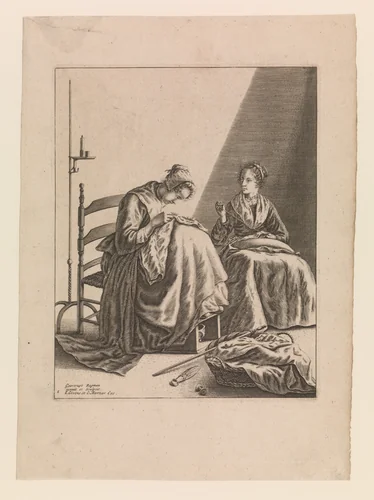
Roghman’s enduring significance rests almost entirely on a series of five distinct engravings, collectively known as Five Feminine Occupations. These works deviate sharply from the idealized, sometimes theatrical, domestic scenes favored by many of her contemporaries. Instead, Roghman rendered subjects such as A Woman Cooking and A Woman Spinning with an exceptional degree of verisimilitude, lending genuine weight to labor typically relegated to the background of 17th-century visual culture. The prints, including precise studies like A Young Woman Ruffling and Two Women Sewing, are not merely records of activity; they are intimate character studies, capturing the quiet concentration required by these essential household tasks.
Her technical command of the copper plate allowed her to achieve rich tonal variations and textural fidelity, which was crucial for conveying the rough fabric of working clothes or the steam rising from a hearth. This dedication to depicting the reality of women’s labor—ranging from sewing to A Woman Doing Housework—with such earnest gravity distinguishes her contribution to the graphic tradition. The five known impressions are today preserved in leading institutions, most notably the Metropolitan Museum of Art, testament to their historical importance.
The medium of printmaking allowed Roghman’s work, unlike private Geertruydt Roghman paintings, to reach a wider public. Today, the enduring quality of these compositions ensures their availability as high-quality prints. As this influential body of work is considered public domain, contemporary audiences benefit from downloadable artwork that provides direct access to Roghman’s quiet yet powerful narrative of 17th-century female experience.
Source: Wikipedia · CC BY-SA 4.0