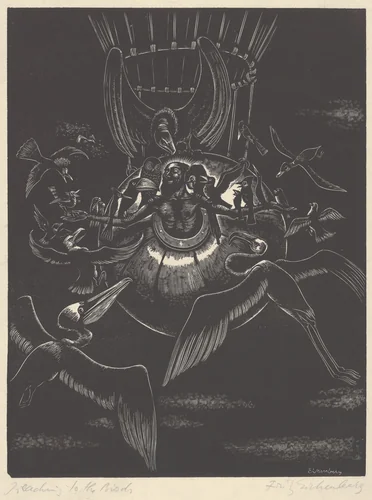
Fritz Eichenberg
Fritz Eichenberg (1901-1990) established himself as a preeminent German-American illustrator and arts educator, a figure whose practice was defined by the rigorous demands of wood engraving. Active from 1935, his contributions to graphic arts provided a crucial visual commentary on the ethical and social dilemmas of the mid-20th century.
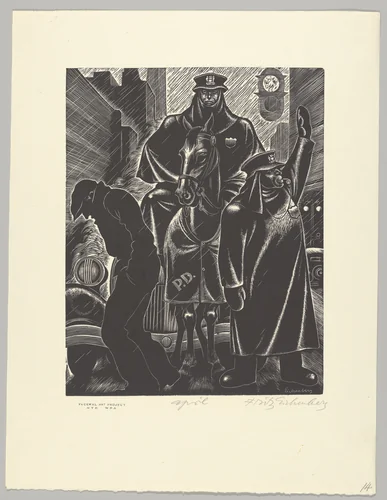
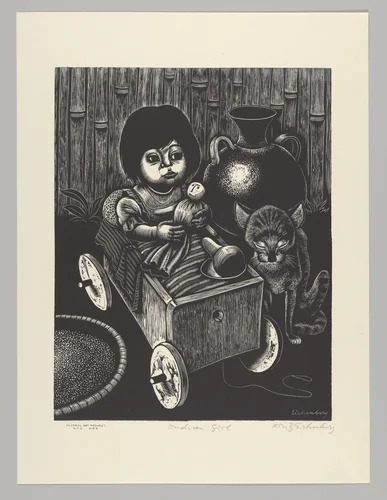
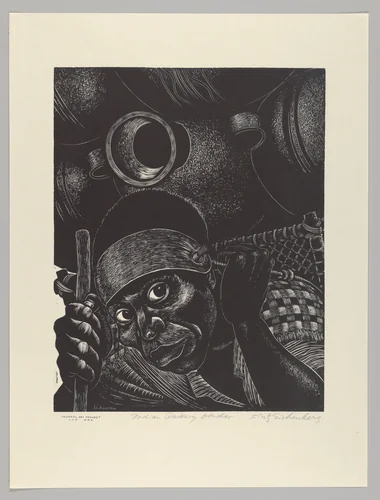
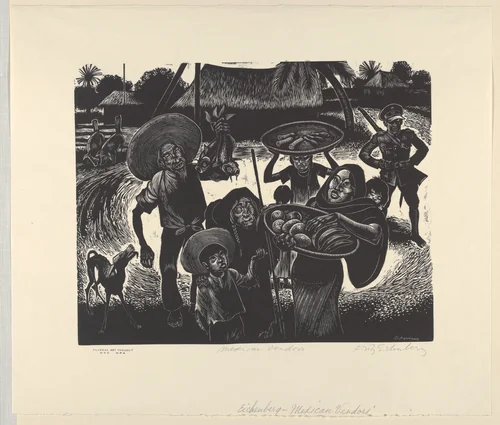
Eichenberg’s primary artistic concerns centered on religion, deep-seated social justice issues, and the advocacy of nonviolence. His compositions, stark and intensely textural due to the subtractive nature of engraving, often placed moral imperatives before purely aesthetic concerns. Following his move to the United States, his work frequently explored the cultural diversity of the Americas, evidenced by pieces such as Indian Girl, Indian Pottery Vendor, and the narrative print Mexican Vendors. While he is noted for his powerful illustrations of classic literature, it is arguably his original graphic work addressing human rights, such as April and Preaching to the Birds, that resonates most directly with contemporary audiences.
Wood engraving is an unforgiving medium, requiring absolute precision; the density of Eichenberg's line work often achieved an almost sculptural quality on the printing block. He mastered this challenging technique, using it not merely for reproduction but as a vehicle for profound philosophical inquiry. Beyond his prolific output of Fritz Eichenberg prints, he dedicated significant time to pedagogy, nurturing new generations of American graphic artists. It is perhaps a quiet irony that an artist so concerned with the moral weight of humanity, who produced such profoundly dark and serious imagery, possessed a surprisingly playful eye for the absurd details of human interaction.
Eichenberg’s artistic integrity secured his place in major institutions, including the permanent collections of the Metropolitan Museum of Art. Because many of these historic pieces are now considered public domain, they allow for renewed scholarly interest and widespread accessibility. The detailed texture and depth of his original work translate effectively into high-quality prints, ensuring that this compelling historical viewpoint remains accessible for study and exhibition. These museum-quality works continue to define the power and potential of 20th-century relief printmaking.
Source: Wikipedia · CC BY-SA 4.0