Frederic Remington
Frederic Sackrider Remington (1861-1909) stands as the preeminent visual chronicler of the American West during the final quarter of the nineteenth century. Working across painting, illustration, sculpture, and writing, Remington specialized in Western American Art, committing his career to documenting the culture and conflict of a vanishing frontier. His factual clarity, dynamic compositions, and singular focus established the enduring imagery of the era for generations of Americans.
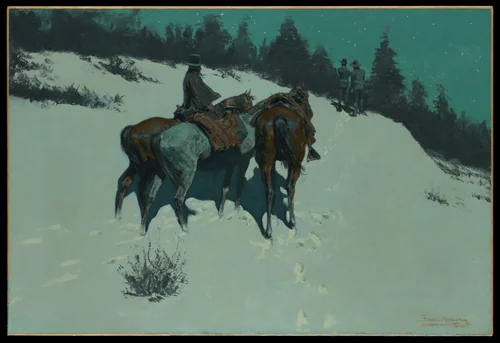
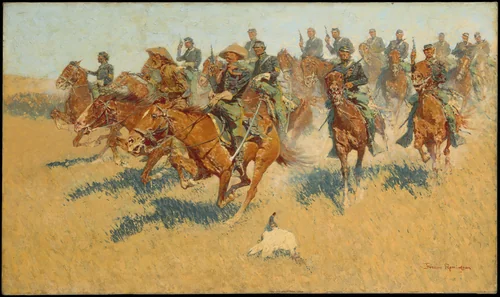
Remington’s reputation rests on his commitment to reportage. Unlike earlier romantic interpreters, he dedicated himself to the authenticity of detail, capturing the specifics of gear, movement, and environment with painstaking accuracy. His powerful depictions of cowboys, the U.S. Cavalry, and Native Americans defined the genre, immortalizing both daily life and dramatic action. While known primarily for kinetic scenes of the arid landscape, such as Pitched It Sheer into the River . . . Where It Still Is Seen in the Summer, his interests occasionally strayed toward the unexpected. The painting On the Bridle Path, Central Park, New York reveals his acute observational skills, applying his Western gaze to metropolitan equestrian society.
The artist’s innovation extended beyond two dimensions. Recognizing the permanence and physicality inherent in the subject matter, Remington became a pioneering figure in American bronze sculpture. He mastered the complex cire perdue (lost wax) technique, using it to capture the instantaneous motion of riders and horses. This mastery ensured his vision achieved a unique three-dimensional presence, cementing his stature in major institutions.
Remington’s works, including key pieces like The Mexican Major and Historians of the Tribe, are foundational to American art history and are held in collections such as the Metropolitan Museum of Art and the National Gallery of Art, affording museum-quality access to his historical record. His artistic influence remains significant. Today, many of his later Frederic Remington paintings and drawings have entered the public domain, making high-quality prints and downloadable artwork widely available for study and appreciation.
Source: Wikipedia · CC BY-SA 4.0