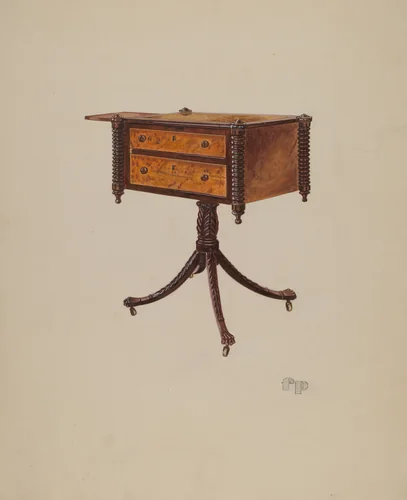
Fred Peterson
Fred Lawrence Peterson secured his place in American visual culture not through creation, but through meticulous preservation and documentation. Active primarily during 1936 and 1937, Peterson was a vital contributor to the Index of American Design (IAD), a seminal Federal Art Project operating under the Works Progress Administration. The IAD aimed to visually preserve the nation's material heritage by creating precise, detailed renderings of pre-1900 American decorative and folk art, thereby safeguarding these artifacts against loss or modernization.
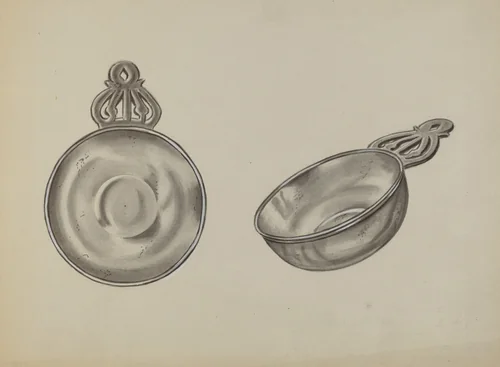
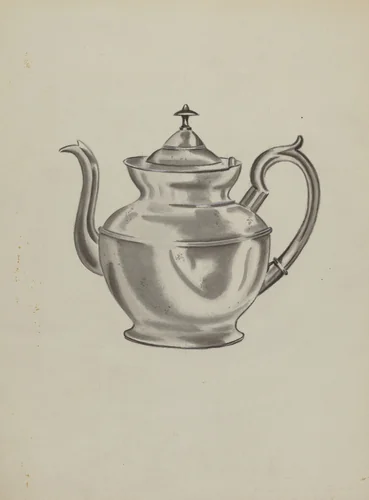
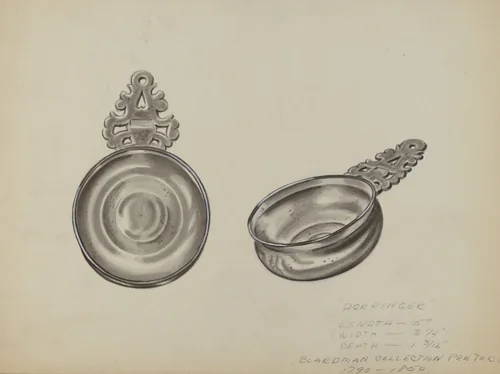
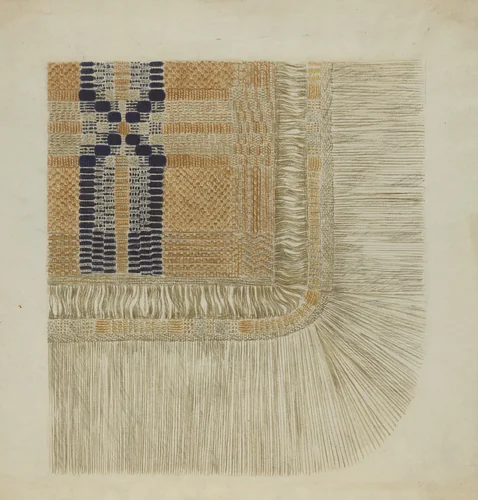
His artistic contribution is cataloged by the five works held in the National Gallery of Art, illustrating the breadth of early American craftsmanship that the IAD sought to capture. Peterson’s technical skill lay in translating three-dimensional artifacts into rigorous, two-dimensional records, often rendered in watercolor or gouache on heavy board. The series encompasses both the strictly functional, such as the design of a Work Table, and the highly textural, like the Handwoven Coverlet (Detail). This emphasis on utilitarian aesthetics is equally evident in his documentation of metalware, ranging from the charmingly scaled Pewter Toy Porringer to the full-size Pewter Teapot and Pewter Porringer. These detailed studies function as museum-quality historical records, offering unparalleled insight into the domestic and material history of the 18th and 19th centuries.
While many IAD contributors remained solely within the fine arts, Peterson’s subsequent trajectory took a distinct turn into public life. A native of Minnesota who grew up in Portland, Oregon, he leveraged his rigorous organizational abilities, honed during the Depression-era project, first in business and later in municipal politics. It is perhaps a reflection of his IAD training, which demanded strict fidelity to form and detail, that he successfully navigated the often unruly machinery of civic governance. He notably served as the Mayor of Portland from 1953 through 1956, marking a unique transition from the careful documentation of Colonial pewter to the management of a modern Pacific Northwest city.
Today, Peterson’s documentation ensures the visual survival of these historic objects. Because the IAD works were commissioned and owned by the U.S. government, these studies, sometimes referenced as Fred Peterson prints, are typically made available in the public domain. This status allows researchers and enthusiasts access to downloadable artwork and high-quality prints for non-commercial study and reproduction, cementing his legacy not just as a civic leader, but as a crucial archival artist of the Depression era.