Fred Becker
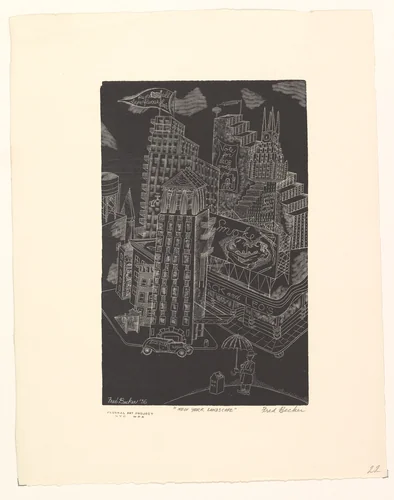
Fred Becker established himself as a significant contributor to American graphic arts during the 1930s, an era when printmaking experienced a powerful resurgence facilitated by federal arts programs. His work, characterized by robust composition and an acute focus on American social life, is represented in major collections, including the Metropolitan Museum of Art. Becker focused primarily on lithography and wood engraving, utilizing the precision of these media to capture the dynamic energy of contemporary genre scenes.
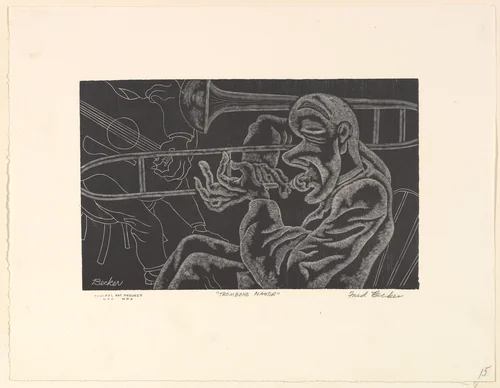
Active around 1935, Becker was highly attuned to the evolving cultural rhythms of the United States. His thematic specialization frequently centered on music and regional folk narratives, providing visual records of community events and foundational American myths. Works such as Arrival of Brass Section and Guitar Player demonstrate his ability to translate the spontaneous movement and sound of live performance into stark, effective black-and-white compositions. These images are not mere static documentation; they resonate with the blues and jazz influences that defined the era.
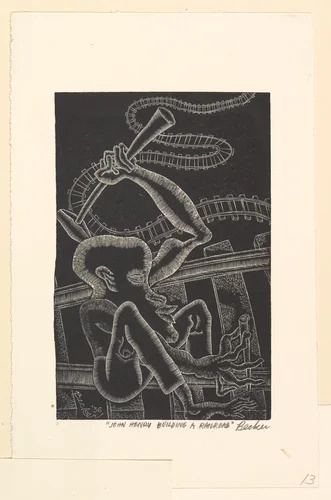
Other key works, including Beale Street Blues and the epic Birth of John Henry, position Becker within the tradition of artists dedicated to immortalizing working-class struggles and legendary figures. His treatment of the Clambake offers a spirited, slightly humorous contrast, focusing on leisure and social interaction with equal technical mastery.
Becker possessed the rare ability to infuse documentary subject matter with genuine dramatic tension. His works convey the rhythm of a culture dedicated to surviving hardship through shared sound and communal ritual. While the quantity of his production may be limited to roughly fifteen documented prints from his early career, the consistent quality and thematic richness of these pieces ensure his continued relevance. Thanks to meticulous museum-quality archiving, many of these compelling Fred Becker prints are today available as high-quality prints, providing royalty-free access to this important chapter of American realism.
Source: Wikipedia · CC BY-SA 4.0