François-Claudius Compte-Calix
François-Claudius Compte-Calix (1813–1880) was a French painter whose refined approach to genre painting and portraiture established him as a reliable presence in the mid-19th-century Parisian Salon system. Born in Lyons, Compte-Calix received his foundational training locally, studying at the fine art school of his native city before entering the studio of J. C. Bonnefond. This initial academic rigor positioned him well for the national stage, leading to his debut at the influential Paris Salon in 1840.
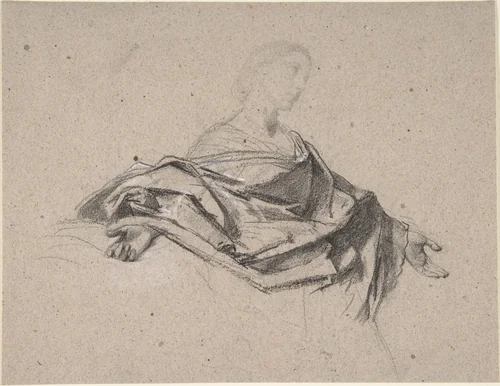
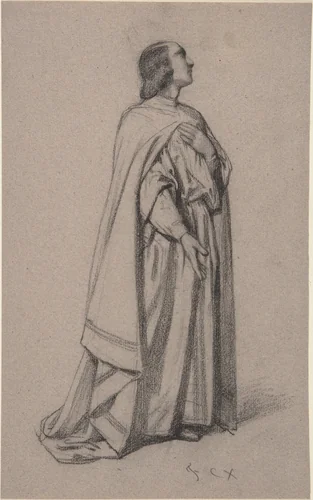
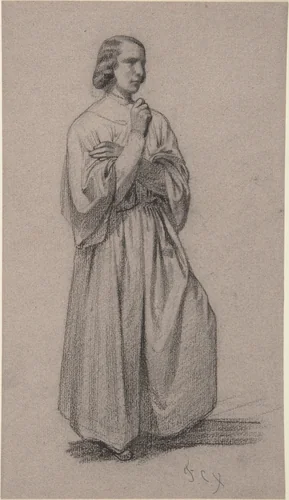
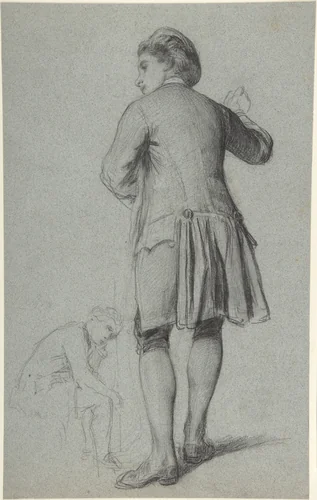
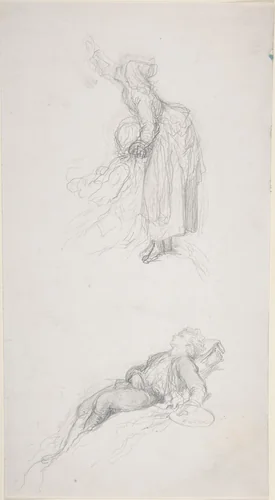
Compte-Calix specialized in narrative scenes that captured the domestic life and social rituals of the emerging bourgeoisie. His work is characterized by meticulous execution and an appealing psychological intimacy, traits that ensured his consistent popularity throughout the Second Empire. While his finished canvases, focused on portraiture and genre subjects, defined his public career, surviving preparatory pieces, such as Half-Length Figure of a Woman with Outstretched Arms and Study of a standing man knocking; sketch of a sitting man, underscore the careful academic study that underpinned his detailed compositions. These figure studies demonstrate the disciplined application of classical drawing methods to contemporary subjects.
A significant recognition of his career came with the inclusion of his painting Vieil Ami (1863) in the monumental 1867 International Exhibition held in Paris. Participation in this seminal event cemented his status among the recognized, if not revolutionary, painters of his generation. The artist's name itself, François-Claudius Compte-Calix, perhaps sounds more evocative of a character from a Balzac novel than a working Salon painter, yet his output anchored him firmly within the established art world.
His sustained dedication to high-quality genre subjects meant his works were highly collectible, and examples remain in important institutional holdings today, notably in the collection of the Metropolitan Museum of Art. For scholars and researchers, many of Compte-Calix’s studies are now in the public domain, making high-quality prints and downloadable artwork accessible for further examination. He died at Chazay d'Azergues near Lyons in 1880, completing a productive career that spanned nearly four decades of major transformations in French art.
Source: Wikipedia · CC BY-SA 4.0