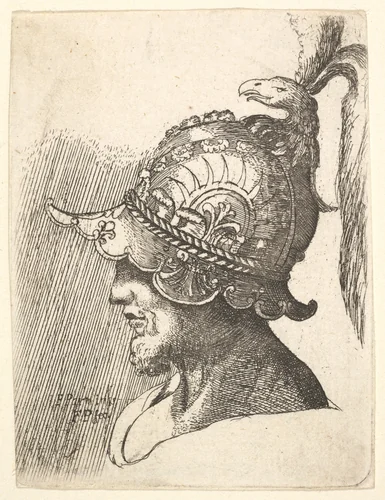
Francis Place
Francis Place (active 1647–1662) holds a distinct, if sometimes chronologically confusing, position within English printmaking history. His limited but significant body of surviving graphic work—comprising four known prints and one drawing—is esteemed enough to reside in major institutions, including the Metropolitan Museum of Art and the National Gallery of Art. The period of his activity places him during a transitional moment in graphic arts, where etching was beginning to shift from a reproductive tool toward an independent means of expression.
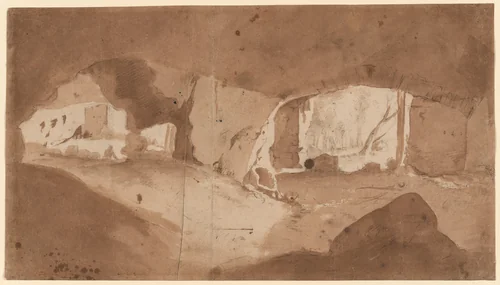
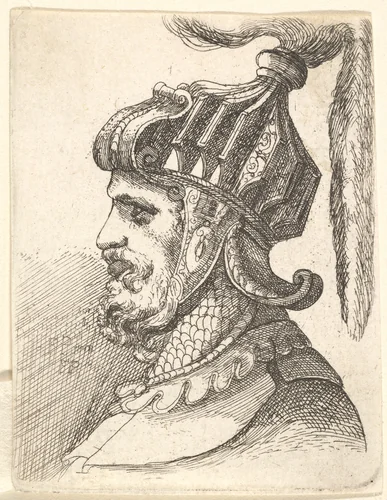
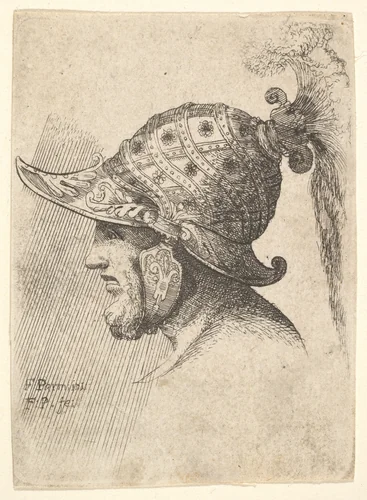
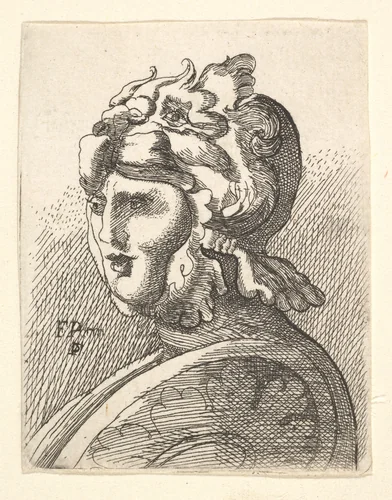
His artistic output reveals a meticulous eye, particularly evident in the architectural study A Grotto (The Stables of the Villa Maecenas, Tivoli?). This print, likely executed in etching or drypoint, demonstrates an engagement with classical topography, a subject gaining great currency in seventeenth-century Europe. Such works were crucial in disseminating ideals of Italian classicism across Northern Europe. The remaining studies, specifically the iterative set of drawings titled Helmeted head, underscore a dedication to mastering form and classical drapery, likely serving as preparatory sketches for larger, perhaps unrealized, commissions. The existence of multiple, slightly varied studies of the same subject confirms a commitment to academic practice.
While Place’s primary legacy rests on the technical precision of these museum-quality graphic works, historical accounts describe a profoundly engaged public life that provides a compelling counterpoint to his studio practice. He was noted as an English social reformer, a figure characterized as "ubiquitous in the machinery of radical London." This fascinating dichotomy—between the quiet discipline required to produce high-quality prints and the demanding environment of political reform—suggests an artist of unusually varied commitment whose life spanned both the studio and the public sphere.
Today, his works are securely established in the public domain. The availability of downloadable artwork ensures that the precision of his seventeenth-century technique remains accessible for modern interpretation and study, preserving the legacy of Francis Place prints for contemporary scholarship.
Source: Wikipedia · CC BY-SA 4.0