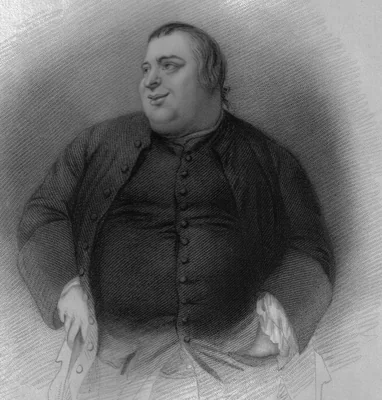
Francis Grose
Francis Grose (1731-1791) occupied a distinctive position in late eighteenth-century British intellectual culture, moving seamlessly between the meticulous documentation of the material world and the standardization of its language. Though known primarily as an antiquary and a draughtsman, his rigorous approach led to foundational literary achievements such as A Classical Dictionary of the Vulgar Tongue (1785) and A Provincial Glossary (1787). This unusual blend of precise historical observation and wry lexicographical humor prepared him for his brief, but highly influential, contribution to visual theory, specifically the categorization of comic art.
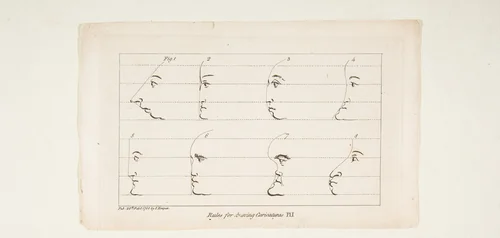
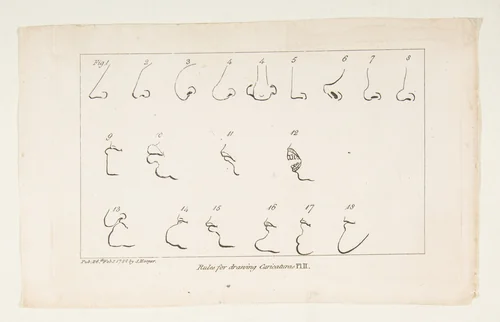
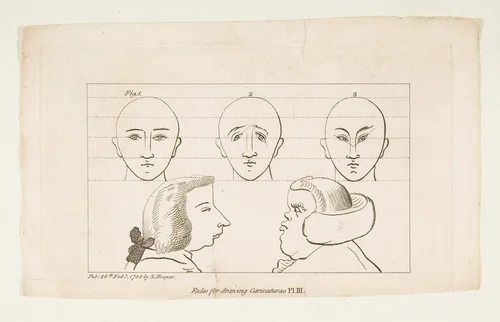
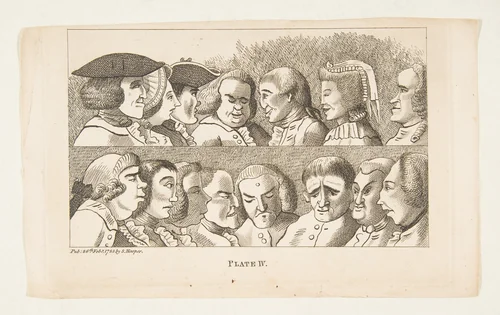
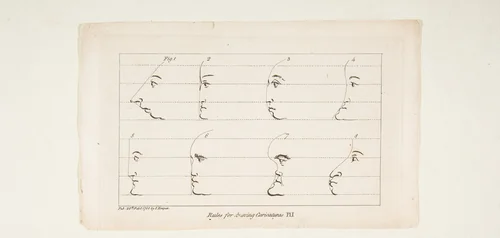
Grose cemented his role as an arbiter of artistic practice with the publication of Rules for Drawing Caricaturas with an Essay on Comic Painting, active during the period of 1788-1789. This manual was crucial, offering a didactic framework for a genre that was rapidly gaining popularity but often lacked formal definition. In an era when caricature was still finding its footing, Grose provided the necessary academic scaffolding, distinguishing ‘caricatura’ (the humorous distortion of an individual’s features) from mere ‘burlesque’ or ‘grotesque.’ The accompanying instructional material, particularly the sequential illustrations Plates I through IV, served as essential teaching tools, visually demonstrating the techniques required for achieving essential exaggeration and anatomical distortion.
The publication established Grose not merely as a chronicler of oddities, but as an authority on drawing technique. It is perhaps fitting that a man who meticulously cataloged the ‘vulgar tongue’ would also write the definitive guide on how to visually mock the elite. As a draughtsman, Grose employed clarity and wit, qualities essential to both his writing and his instruction. His manual reveals a subtle, yet firm, intellectual control over the otherwise riotous world of visual comedy.
Today, the legacy of Grose’s instructional work endures within significant collections, including the Metropolitan Museum of Art. These foundational works, which once guided aspiring eighteenth-century satirists, are available as high-quality prints and frequently accessible through the public domain, securing his status not only as a compiler of archaic words, but as an architect of the rules of visual satire.
Source: Wikipedia · CC BY-SA 4.0