Francis Dodd
Francis Dodd (1874-1949) was a distinguished Welsh painter and draftsman whose career, spanning the late Victorian and early Georgian periods, solidified his reputation as a sensitive chronicler of both urban environment and intellectual portraiture. Active particularly between 1884 and 1919, Dodd cultivated a precise, highly skilled approach to etching and drypoint, capturing the specificities of London architecture and the nuanced character of his sitters. His works are held in institutional collections globally, including the Rijksmuseum and the Cleveland Museum of Art, confirming his status as a master observer of sustained art historical relevance.
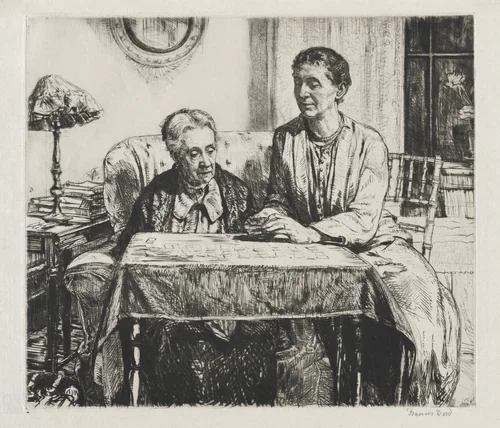
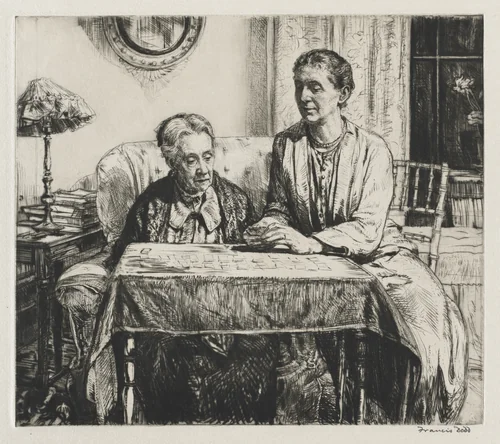
Dodd’s artistic output is characterized by a commitment to rigorous realism coupled with an intimate psychological insight. He excelled in translating the atmosphere of civic spaces, as demonstrated by the architectural precision found in works like Gezicht op de boulevard voor Somerset House. His strength, however, lay equally in the genre of domestic study. Prints such as Portret van een naaiende onbekende vrouw op een bank voor het raam offer quiet, contemplative glimpses into private life, utilizing light and shadow to establish mood rather than merely recording details.
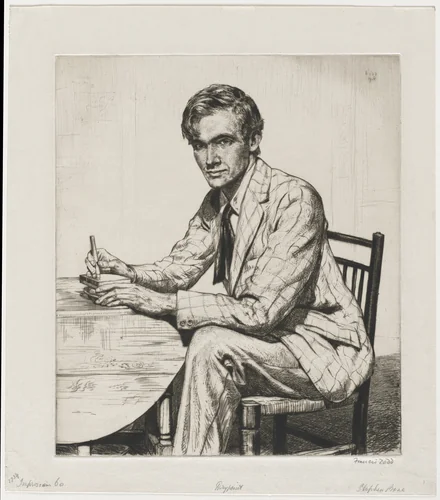
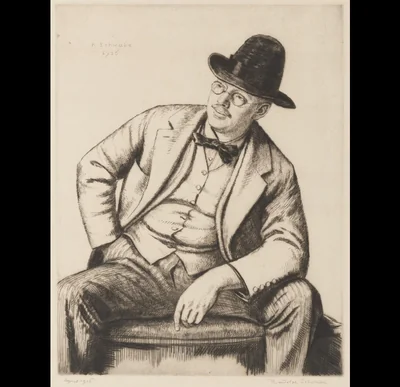
A significant element of Dodd’s legacy rests on his prolific portraiture of contemporaries. He possessed an acute capacity for immortalizing the intellectual and artistic figures of his era, achieving a likeness that captured professional identity alongside personal disposition. His subjects often included influential members of the arts establishment, captured with an economy of line that speaks to his complete command of the drypoint technique. Notable examples include his sharp renderings of Campbell Dodgson, the highly respected Keeper of Prints and Drawings at the British Museum, and the insightful depiction of A. J. Donkin. While Dodd specialized in documenting the precise character of others, it is perhaps fitting that the man who gave so much detail to the public record left surprisingly few exhaustive accounts of his own private pursuits, allowing the work itself to remain the primary document.
Today, Dodd's relevance is sustained by the widespread availability of his legacy. Given the timing of his career, many of his compelling etchings and Francis Dodd prints have entered the public domain. This ensures that museum-quality reproductions, often available as downloadable artwork, continue to circulate, allowing contemporary audiences to appreciate the focused draughtsmanship that defined early 20th-century figurative art.
Source: Wikipedia · CC BY-SA 4.0