Francesco Granacci
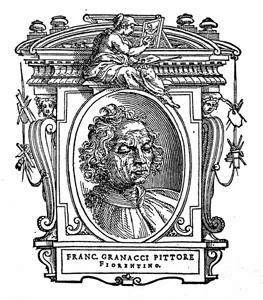
Francesco Granacci (c. 1469–1543) occupies an intriguing, if sometimes overlooked, position within the Florentine High Renaissance. Active primarily in his native city, his standing during his lifetime was notably high, evidenced by his indispensable inclusion in Giorgio Vasari’s foundational text, Lives of the Artists. This biographical recognition immediately situates Granacci not merely as a competent craftsman, but as an essential contributor to the historical narrative of Italian painting, despite his relative obscurity in modern memory.
Granacci’s period of greatest activity, concentrated between 1505 and 1515, placed him at the core of artistic transition in Florence. His style absorbed the precise linear draftsmanship characteristic of the Quattrocento school while evolving toward the monumentality and controlled emotion required by the emerging High Renaissance aesthetic. A significant portion of his known oeuvre focuses on complex devotional subjects and narrative cycles, demonstrating a capacity for visual storytelling.
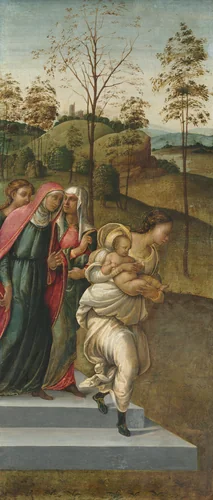
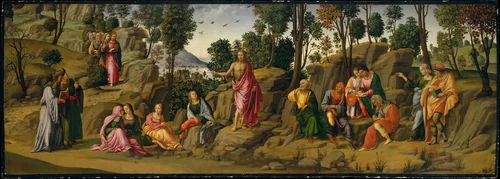
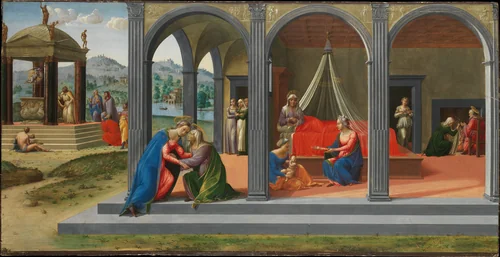
His compositions frequently feature robust figure placement and subtle emotional exchange, as seen in his focused studies of the Evangelist. The sequence detailing the life of the precursor, including John the Baptist being carried to Zacharias and Saint John the Baptist Bearing Witness, exemplifies his skill in synthesizing multiple events within a unified space. These Francesco Granacci paintings illustrate a careful attention to the evolving standards of religious iconography.
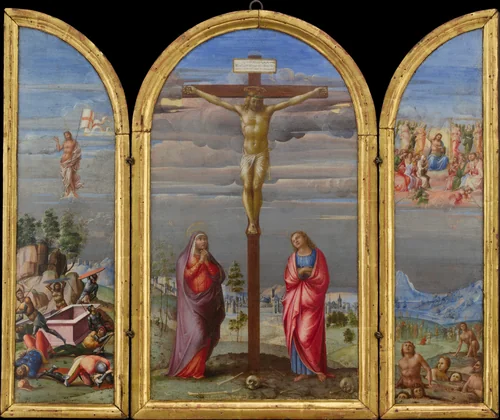
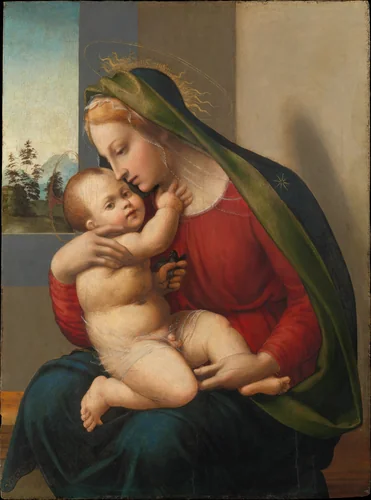
The enduring museum-quality of Granacci’s production is affirmed by their presence in prestigious collections; works such as the devotional Madonna and Child and the large-scale The Crucifixion are held by institutions including the Metropolitan Museum of Art and the Cleveland Museum of Art. It is perhaps one of the peculiar ironies of art history that proximity to titans like Leonardo da Vinci and Michelangelo, with whom Granacci shared early training, often leads to historical diminishment of adjacent masters. Nevertheless, his visual precision remains highly valuable for scholarly study. Today, enthusiasts seeking to study the intricacies of his craft can find many quality reproductions of Francesco Granacci prints, increasingly available as downloadable artwork through digitized collections.
Source: Wikipedia · CC BY-SA 4.0