Francesco de Mura
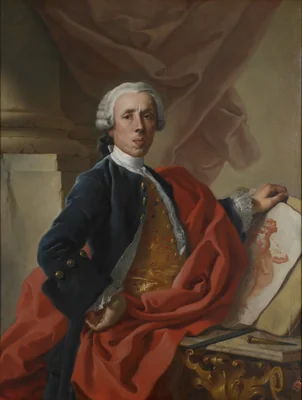
Francesco de Mura (1696-1760) stands as a pivotal Italian painter whose lengthy and productive career coincided precisely with the transition from the high drama of the Late-Baroque era to the measured clarity of nascent Neoclassicism. Primarily active between Naples, the vibrant artistic hub of Southern Italy, and the sophisticated northern court of Turin, De Mura distinguished himself as a master draftsman and a highly sought-after designer for vast decorative schemes.
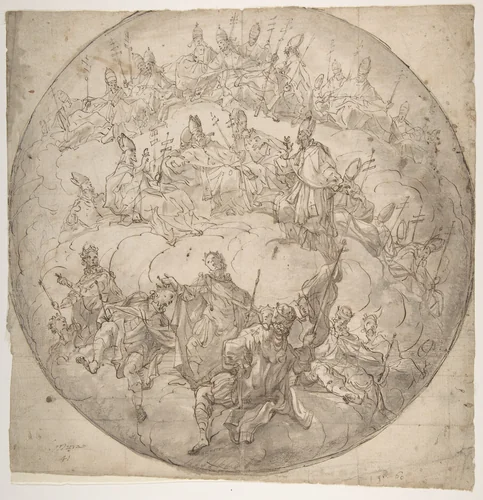
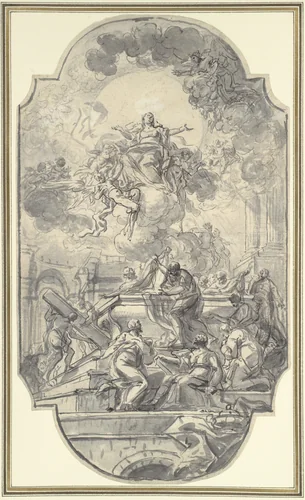
As an artist rooted firmly in the eighteenth century, De Mura excelled in executing the grand public commissions demanded by ecclesiastical and royal patrons. His capabilities in managing complex narratives within architectural settings are evident in designs such as Kings, Bishops and Popes: design for ceiling, which demonstrates a confident handling of crowded, allegorical space. Throughout the first half of the century, De Mura’s style remained aligned with the Neapolitan tradition, characterized by rich coloration and robust figure drawing.
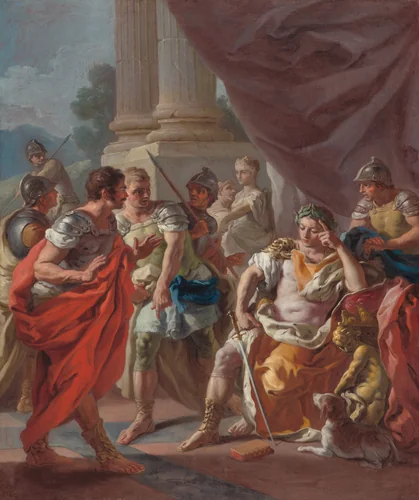
However, the final decades of his working life reveal a distinct and significant stylistic evolution. Moving away from theatrical Baroque gestures, De Mura adopted the cooler palette, linear purity, and intellectual restraint associated with emerging Enlightenment taste, aligning his work with the principles of early Neoclassicism. This late transition underscores his awareness of international artistic trends and his willingness to shed the stylistic norms of his youth, resulting in superb examples of Francesco de Mura paintings that bridge two distinct eras.
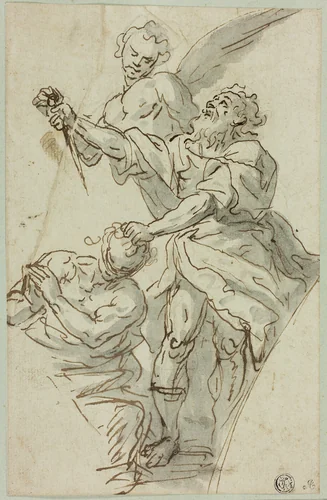
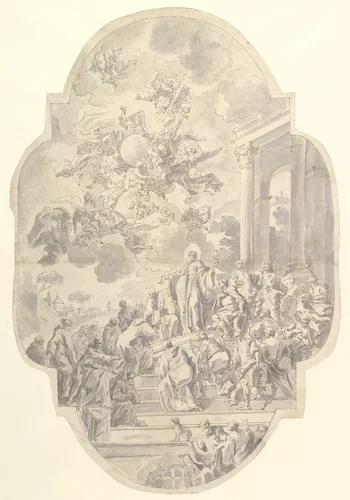
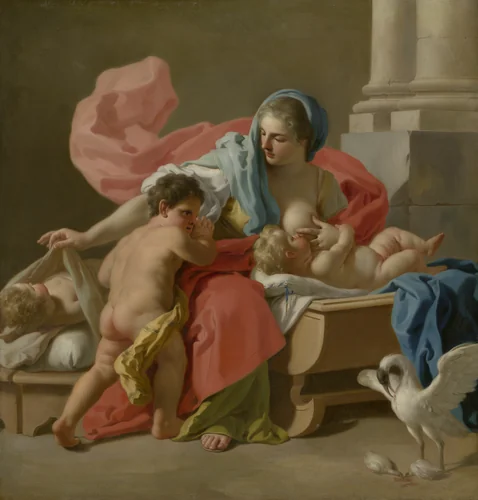
De Mura’s enduring legacy is built upon his sophisticated religious canvases, including The Vision of Saint Benedict and The Assumption of the Virgin, and his compelling, immediate preparatory work, like the Sketch of Spandrel with Sacrifice of Isaac. It is worth noting that while he was a celebrated master of the grand narrative, his numerous surviving drawings suggest he approached compositions with an almost cautious architectural meticulousness. Today, major examples of his output, such as Charity, are preserved in international collections like the National Gallery of Art, providing museum-quality access to his distinctive approach. Furthermore, many of his key works are now in the public domain, allowing high-quality prints of Francesco de Mura prints to reach a wider audience.
Source: Wikipedia · CC BY-SA 4.0