Fortunato Duranti
Fortunato Duranti (1787-1835) was a distinguished Italian painter and collector whose precise, often dramatically rendered, drawings bridge the late Neoclassical period and the nascent Romantic movement. Though historically his renown rested equally on his activities as a discerning collector, his surviving body of work, securely held in globally significant institutions such as the Metropolitan Museum of Art and the National Gallery of Art, confirms his status as a talented and sophisticated draftsman.
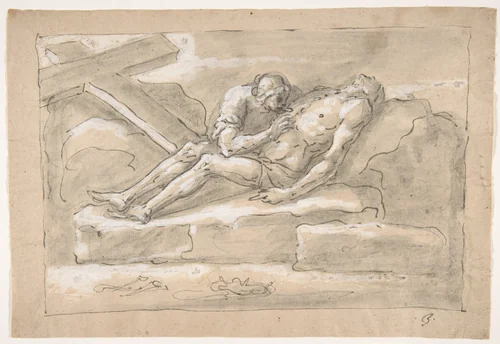
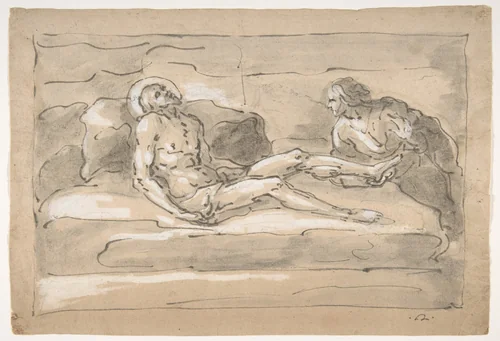
Duranti’s artistic output demonstrates a consistent preoccupation with narrative intensity and psychological detail, often executed in rigorous pen-and-wash techniques across a relatively small format. His handling of spiritual subjects is particularly powerful, notably in the related studies focusing on the aftermath of the Crucifixion. The drawings The Dead Christ Mourned by the Magdalen Who Venerates His Side Wound and the equally moving The Dead Christ Mourned by the Magdalen Who Venerates the Wounds on His Feet showcase a mastery of high pathos achieved through careful composition and a subtle manipulation of light and shadow.
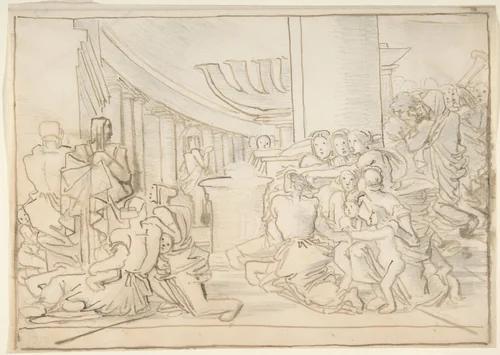
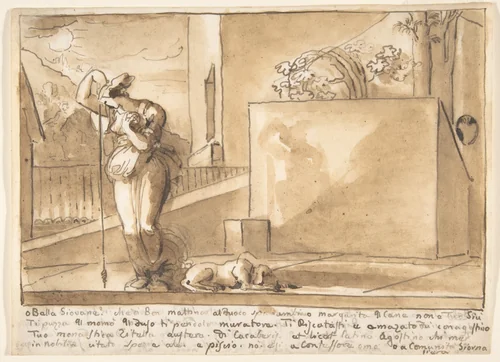
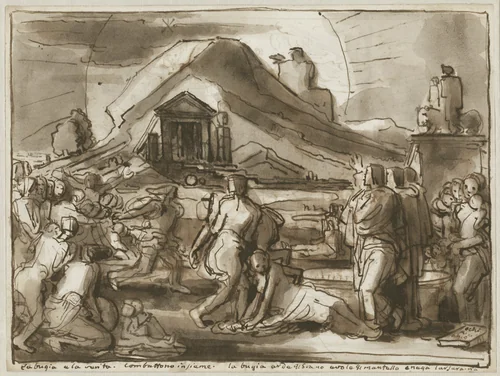
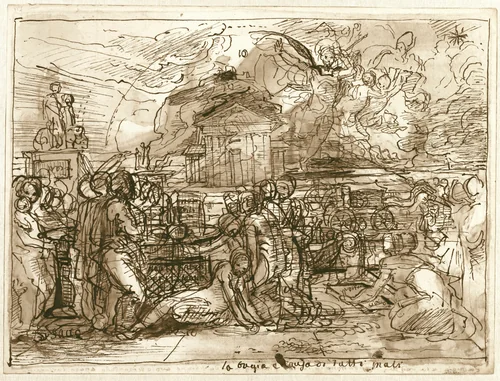
Allegory formed a critical component of Duranti’s intellectual practice, exemplified by the layered study An Allegory of Truth and Falsehood, and his religious scenes, such as the detailed Congregation in a Temple, reveal an interest in complex architectural and figural arrangement. Even when focused on classical studies, such as O Bella Giovane, his commitment to ideal form is rendered with an almost meticulous energy.
Beyond his primary vocation, Duranti built a considerable reputation as a steward of historical artifacts. His dual role as an artist and a collector arguably provided him with a unique, self-reflexive perspective on artistic legacy and market value. It is perhaps unsurprising that an artist so concerned with the careful preservation of others' masterpieces ensured his own work survived; this dedication contrasts sharply with many contemporaries whose preparatory drawings have been lost to time. While the total number of Fortunato Duranti paintings remains small, the availability of museum-quality drawings ensures his continued relevance to 19th-century Italian art studies. These highly refined works, often available as high-quality prints in the public domain, offer valuable insight into the drawing styles prevalent during the transition from the Napoleonic era into the later 1830s.
Source: Wikipedia · CC BY-SA 4.0