Fortunato Depero
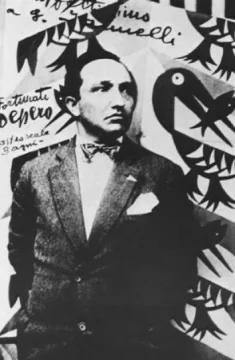
Fortunato Depero (1892–1960) was a pivotal figure in 20th-century Italian art, seamlessly spanning the roles of painter, sculptor, writer, and prolific graphic designer. A key exponent of Futurism, Depero distinguished himself by rigorously applying the movement’s principles of speed, dynamism, and typographic boldness not merely to traditional canvases but to the expanding sphere of commercial and applied arts. This commitment to marrying avant-garde concepts with everyday objects established him as a crucial precursor to modern advertising and product design. His vision of arte totale (total art) meant that the kinetic energy of Futurism could be held in the hand—whether as a book, a highly stylized piece of furniture, or an advertisement.
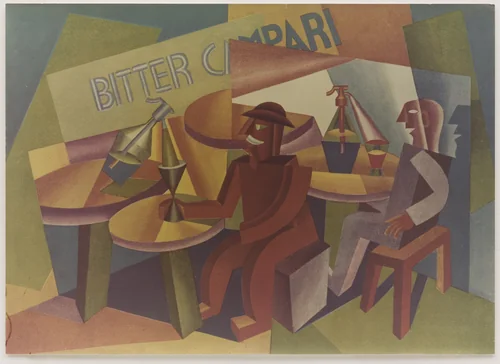
The concentrated period between 1926 and 1928 showcases Depero at the height of his graphic design output, during which he defined a distinctive, high-impact aesthetic. Works commissioned during this time, such as his striking design for Bitter Campari, demonstrate a confident use of pure geometric abstraction and arresting primary color schemes intended to seize immediate public attention on the street or in print.
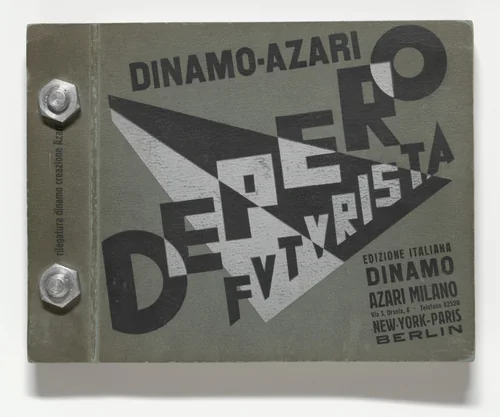
Equally significant was his self-published 1927 monograph, Depero Futurista, often referred to simply as the "bolted book." Bound using substantial industrial bolts rather than traditional stitching, the book functioned simultaneously as a manifesto, a portfolio, and a sculptural object—a definitive statement about integrating industrial technology and materials directly into artistic creation. This focus on tactile, multi-media production ensured that Depero’s influence transcended the boundaries of the traditional gallery space.
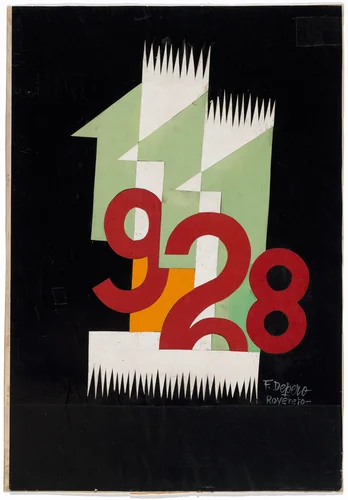
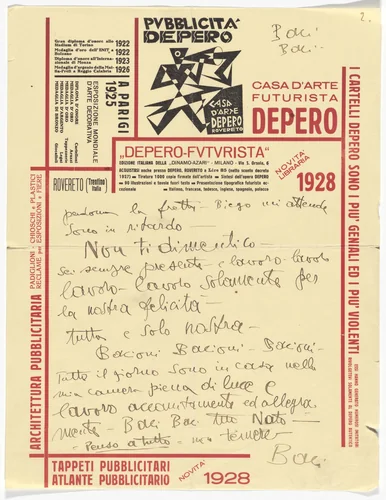
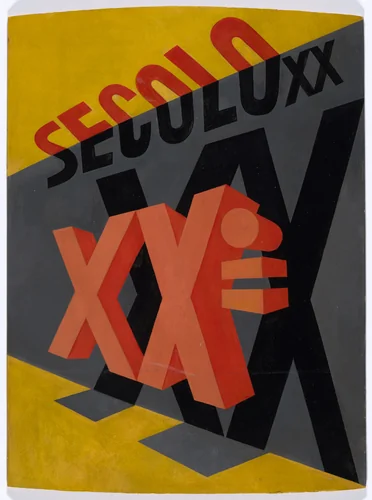
Depero’s visual language was characterized by a sophisticated playfulness and controlled exuberance. Even in utilitarian pieces, such as the Fortunato Depero letterhead or the detailed Maquette for cover of the journal Secolo XX, there is an evident conviction that art should permeate professional life; the way he handled his own stationary speaks volumes about his commitment to the principles of Futurism. His foundational role in translating avant-garde concepts into commercial viability is acknowledged by his presence in major institutional holdings, including the Museum of Modern Art. Today, many significant examples of Fortunato Depero prints and designs are widely available in the public domain, ensuring that high-quality prints and downloadable artwork remain accessible for contemporary study and appreciation.
Source: Wikipedia · CC BY-SA 4.0