Flaminio Innocenzo Minozzi
Flaminio Innocenzo Minozzi (active 1700-1750) was a pivotal Italian master of quadratura, the highly demanding practice of illusionistic architectural painting. Trained in Bologna, the crucible of Italian design, Minozzi developed a specialization that elevated painted perspective to the level of genuine structural intervention. His career represents the height of demand for sophisticated decorative artists capable of transforming flat surfaces into dramatic, Baroque three-dimensional environments.
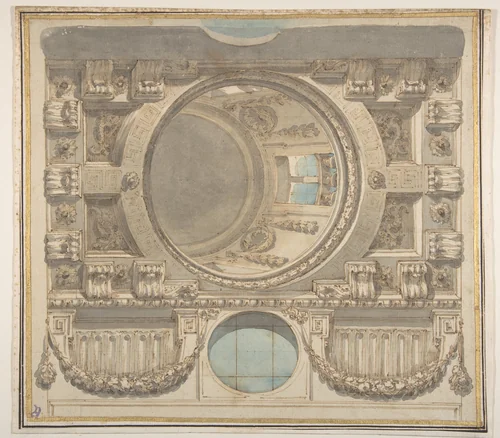
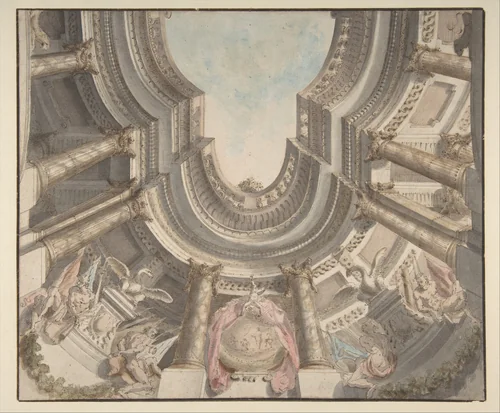
Minozzi began his formal artistic education under his father, Bernardo Minozzi, a noted landscape painter. However, Flaminio soon established his own technical path, focusing intently on architectural design and spatial manipulation. His early excellence was recognized by the Accademia Clementina, where he earned the prestigious Marsili-Aldrovandi Award, marking him as a rising star within the Bolognese school. This early acclaim led to a significant professional affiliation with Carlo Galli Bibiena, a scion of the famed dynasty celebrated across Europe for theatrical and palatial design. Working alongside Bibiena allowed Minozzi to refine the monumental scale and dramatic flair evident in works like his Architectural Design for a Ceiling with a Dome.
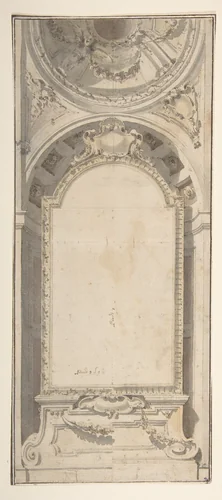
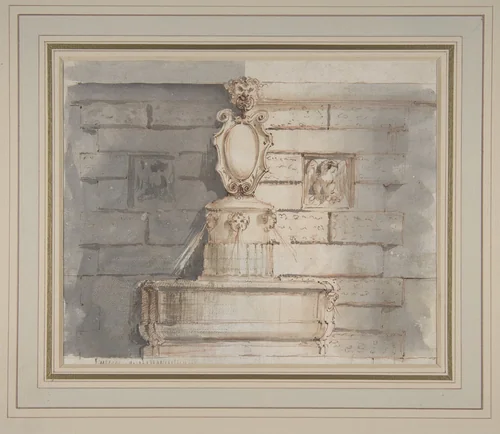
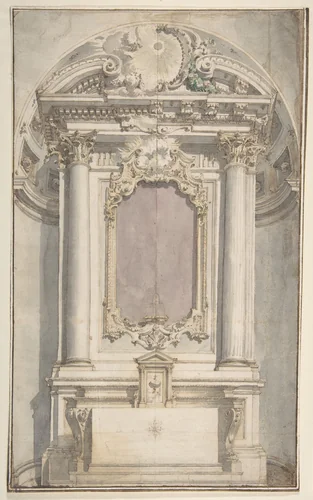
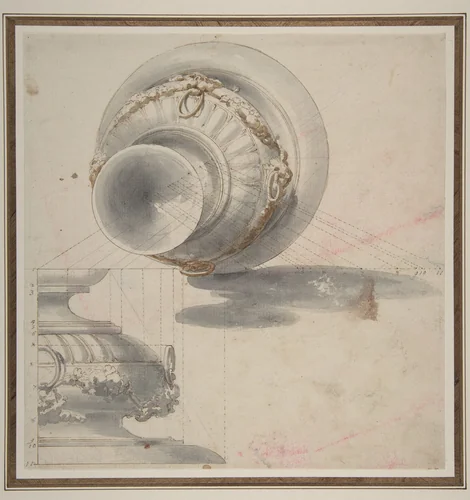
Although his finished paintings are rare, Minozzi’s legacy is preserved compellingly through his detailed architectural studies and preparatory drawings, seven of which are held in institutions like the Metropolitan Museum of Art. These documents confirm his versatile competence, spanning intricate ecclesiastical structures and civic planning. One might observe that Minozzi appeared equally comfortable devising monumental altarpieces, as seen in Architectural Design with an Altarpiece Framed in a Niche and Surmounted by a Dome, and designing municipal projects, such as the detailed plans for Design for a Fountain at a Street Corner Decorated with Putti Heads, a Coat of Arm and a Gargoyle Head on the Top. Minozzi’s international importance was cemented later in his career when he relocated to work in Lisbon, confirming the high currency of his specialized illusionistic skills across European courts.
Today, scholars rely on these precise compositions, available to researchers as Flaminio Innocenzo Minozzi prints. Many of these historically significant designs are now in the public domain, making high-quality prints and downloadable artwork accessible globally, allowing for close study of this crucial figure in 18th-century Italian architectural imagination.
Source: Wikipedia · CC BY-SA 4.0