Ferraù Fenzoni
Ferraù Fenzoni (c. 1562-1645), often known by the regional moniker ‘Il Faenzone’ after his native city, stands as a significant bridge figure within Italian art, operating decisively at the transition point between the High Mannerism of the late sixteenth century and the emerging Baroque sensibility. Trained primarily in Rome during his formative years, Fenzoni established himself as a dedicated practitioner of both fresco and canvas painting, concentrating his output almost exclusively on biblical and religious narratives.
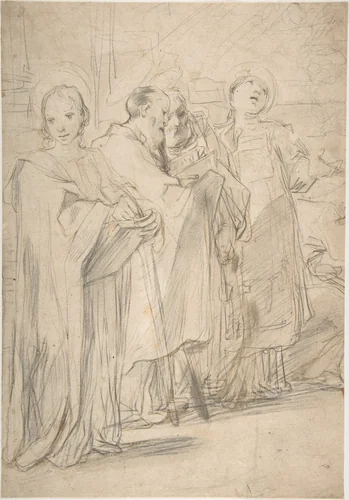
Fenzoni’s youth was spent immersed in the demanding artistic environment of Rome, providing him with a profound classical foundation that underpinned his mature style. Returning to central Italy, he secured important and ambitious commissions in Todi and subsequently in Faenza, where his influence helped sustain the refined, often emotionally charged, Mannerist aesthetic well into the early seventeenth century. His work is characterized by elongated forms, subtle yet dramatic psychological intensity, and a highly polished execution, features evident in major compositional studies such as Saints John the Evangelist, Paul, Peter, and Stephen.
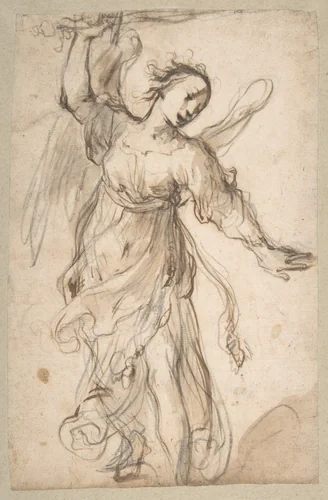
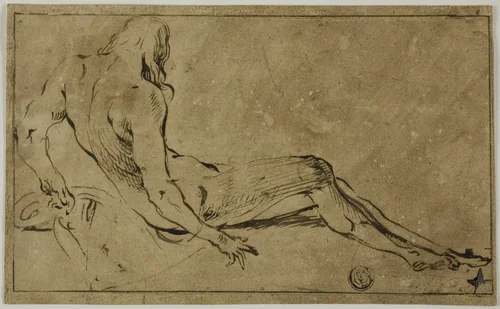
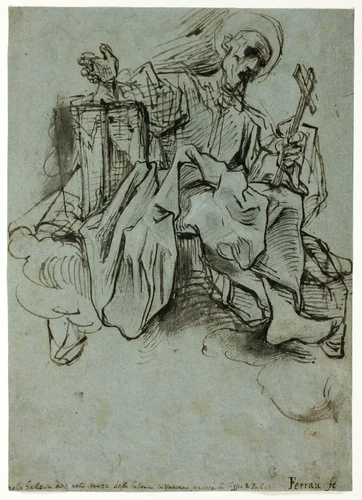
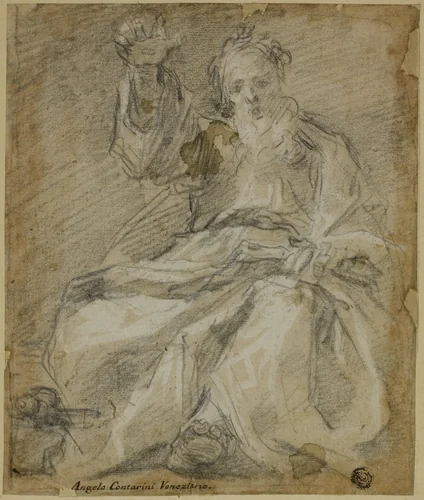
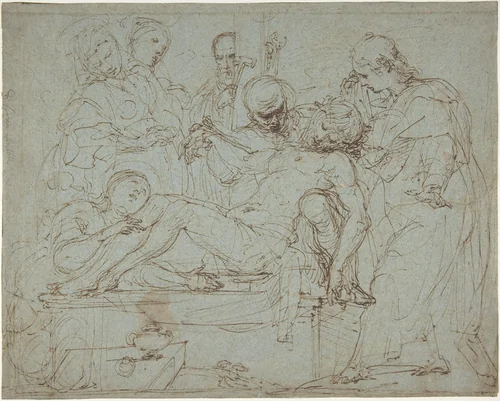
While recognized publicly for his large-scale paintings, it is through his surviving corpus of drawings that Fenzoni’s distinctive draughtsmanship is most clearly appreciated today. His facility with chalk and pen reveals a dynamic engagement with human anatomy, utilizing the contorted poses and linear tension characteristic of the late Roman school. Studies like Standing Angel Brandishing a Sword and the academic preparatory work Reclining Male Nude, from Behind showcase his masterful control of line, precision, and form, essential skills indicative of museum-quality execution.
Although he is sometimes overshadowed by contemporaries who aggressively pursued the naturalism of the rising Baroque, Fenzoni’s contribution remains vital to understanding the sustained legacy of sophisticated Roman Mannerism. It is perhaps telling that his enduring nickname, ‘Il Faenzone,’ grounds him firmly in his birthplace, suggesting an artist content to elevate regional Italian art through sustained, high-quality production rather than continuous stylistic novelty. Today, his significant works reside in premier institutions, including the Metropolitan Museum of Art and the Art Institute of Chicago, providing invaluable insight into the final flourishing of the sixteenth-century style. Many of these important drawings are available as downloadable artwork in the public domain, offering exceptional access to Ferraù Fenzoni prints for study and appreciation worldwide.
Source: Wikipedia · CC BY-SA 4.0