Federico Zuccaro
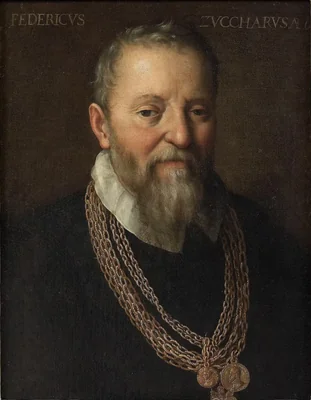
Federico Zuccaro (c. 1540-1609), also known as Federico Zuccari, was one of the preeminent figures who defined the complex trajectory of Italian art during the final phase of Mannerism. His significance is derived not only from his prolific output as a painter and draughtsman, but also from his complementary roles as an architect and an influential writer on artistic theory. Zuccaro’s career demonstrated an extraordinary geographical ambition rarely matched by his contemporaries; he maintained active workshops across Italy while undertaking major commissions in Spain, France, the Spanish Netherlands, and England. This international mobility made him a crucial vector for the dissemination of Roman visual principles across Northern Europe, cementing his position as a highly sought-after court artist.
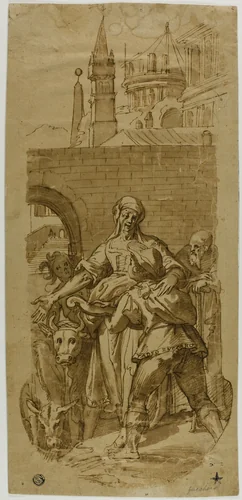
While Zuccaro executed monumental fresco cycles, including extensive decorations in the Vatican and the Florentine Duomo, his lasting technical legacy is often best preserved in his remarkable drawing practice. His comprehensive oeuvre includes meticulous preparatory studies, sophisticated mythological scenes, and expressive religious compositions. Drawings such as Ecce Homo or the ambitious Design for a "Quarantore" Decoration reveal his mastery of line, chiaroscuro, and the complex placement of figures, characteristics fundamental to late Mannerism. The designs for temporary decorative schemes like the Quarantore specifically highlight his talent for integrating painting and architectural concepts on a monumental scale. A substantial portion of his extant work, including studies like the Half-Length Study of a Man Standing in Frontal View, Leaning on Armor and Accompanied by a Boy, showcases his facility for dynamic portraiture and anatomical tension.
Zuccaro was intensely ambitious, both artistically and theoretically. He was instrumental in establishing the professional status of the artist, serving as a founding member and the first Principe of the Accademia di San Luca in Rome. (Interestingly, Zuccaro was known occasionally to use a self-referential pun on his name, Zucchero, meaning sugar, subtly suggesting the perceived sweetness or refinement of his art.) Today, his influence on European drawing traditions is evident in major holdings at institutions like the Rijksmuseum and the Metropolitan Museum of Art. Many of these important historical documents are now in the public domain, offering opportunities for those seeking museum-quality high-quality prints and royalty-free access to both Federico Zuccaro paintings and his extensive corpus of drawings.
Source: Wikipedia · CC BY-SA 4.0