Eva Gonzalès
Eva Gonzalès (1849-1883) holds a distinct and essential position within the history of French Impressionism, acknowledged as one of the four most significant female practitioners of the movement, a cohort that included Mary Cassatt, Berthe Morisot, and Marie Bracquemond. Active professionally for only fifteen years, her succinct career focused almost exclusively on intimate interior scenes, portraiture, and highly nuanced depictions of Parisian domestic life.
Gonzalès received formative training in the studio of the academic painter Charles Chaplin before taking the historically significant step of becoming the sole official student of Édouard Manet in 1869. This unique mentorship profoundly shaped her artistic development; she employed a restrained palette and strong tonal contrasts often associated with Manet’s aesthetic, distinguishing her canvases from the brighter, looser brushwork favored by Monet and Renoir. This alignment with her mentor also influenced a crucial professional choice: unlike Cassatt and Morisot, Gonzalès never exhibited with the official Impressionist group shows, instead preferring to maintain allegiance to the official Salon throughout her career.
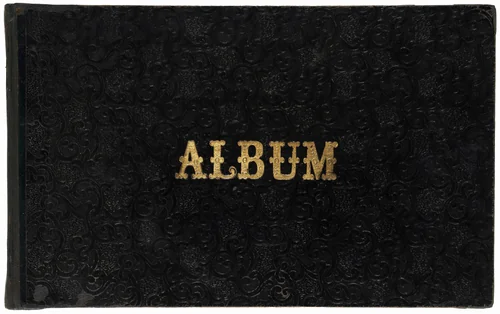
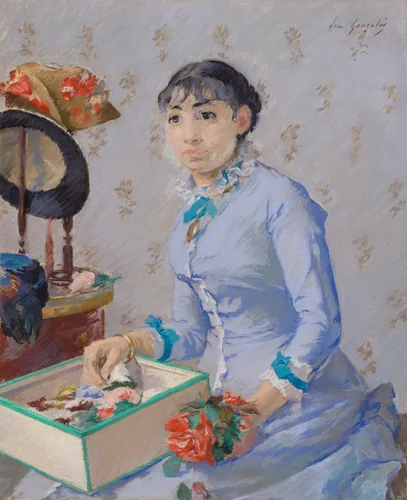
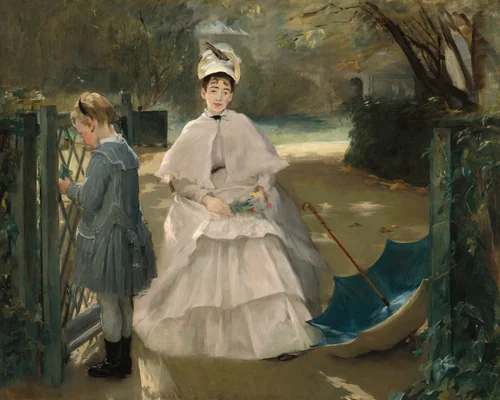
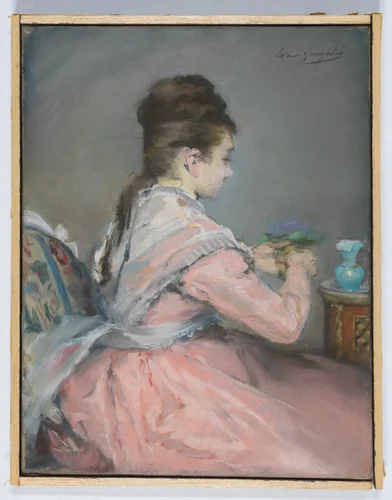
The surviving corpus of her work, though small, showcases an exceptional command of subject and technique. Major pieces such as The Milliner and Nanny and Child exemplify her capacity to render the quiet psychological intensity of her subjects. Her focused body of work consists of just two major paintings, two finished drawings, and a comprehensive extant Sketchbook, the latter offering important insights into her process and meticulous preparatory work. Even the simple still life The Bouquet of Violets reflects a commitment to capturing transient beauty with clarity and precision.
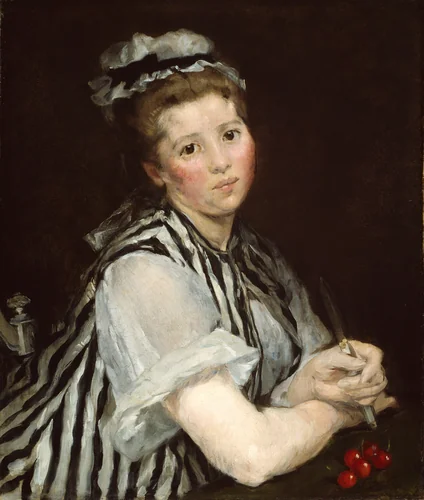
Gonzalès’s distinct contribution to 19th-century painting has been increasingly recognized posthumously. Today, her notable works, including the sophisticated portrait Girl with Cherries, are housed in prestigious international institutions like the National Gallery of Art, the Art Institute of Chicago, and the Metropolitan Museum of Art. For admirers of 19th-century French Impressionism, Eva Gonzalès paintings retain their enduring museum-quality status. Her impressive synthesis of Manet’s technical rigor and the modern observation inherent in Impressionism solidifies her essential, if tragically curtailed, legacy.
Source: Wikipedia · CC BY-SA 4.0