Eugène Verboeckhoven
Eugène Joseph Verboeckhoven (1798-1881) stands as a prominent figure in 19th-century Belgian art, distinguished by his comprehensive mastery of both traditional and mechanical visual media. Unlike contemporaries who focused solely on painting, Verboeckhoven fluently navigated the roles of painter, sculptor, etcher, engraver, and lithographer. This versatility ensured his influence extended far beyond the gallery walls and into the broader European print culture during his active period.
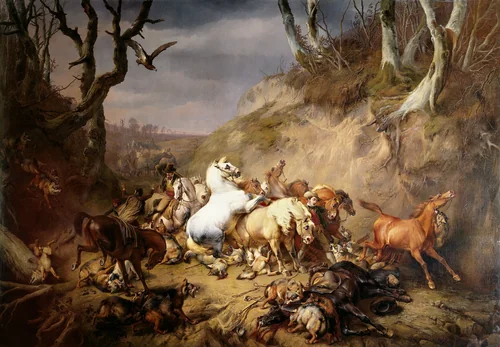
His primary artistic focus centered on animals and the animated landscape, a genre he approached with scientific precision and an eye for natural drama. Verboeckhoven possessed a particular gift for rendering livestock, making subjects such as Ezel bij hek and Jonge koe appealingly lifelike. These pastoral scenes are often celebrated for their exquisite lighting and atmospheric quality, exemplified in works like Landschap met stier. Although renowned for domesticated animals, he also explored more dramatic natural history, visible in the intense detail of Kop van een wolf. His meticulous animal studies served not only as finished artworks but also as invaluable reference material for students seeking accuracy.
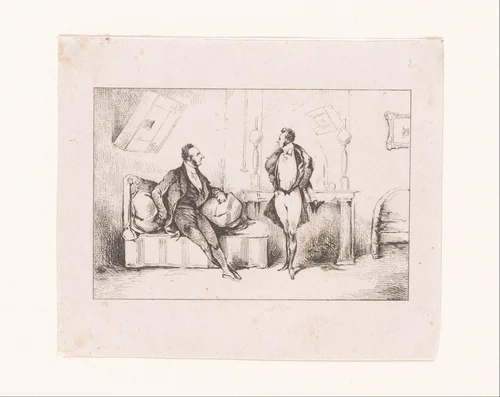
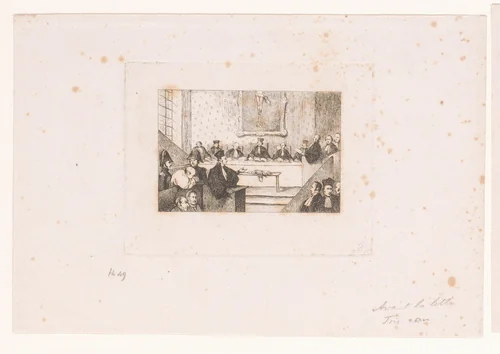
Verboeckhoven’s extensive activity in etching and lithography was central to his legacy. By embracing print techniques that allowed for relatively rapid reproduction, he secured widespread dissemination for his compositions across the Continent. This accessibility meant that numerous Eugène Verboeckhoven prints, created primarily for distribution to a middle-class market, are now considered museum-quality examples of early 19th-century graphic arts. The enduring appeal of these meticulous studies means that much of his downloadable artwork is today available through the public domain, benefiting researchers and collectors globally.
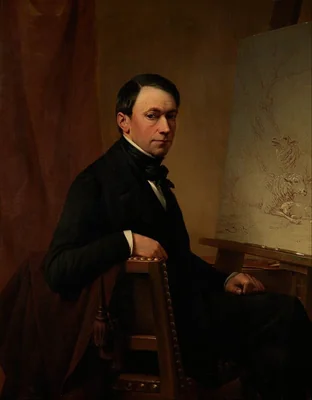
While known primarily for his fauna, Verboeckhoven was equally adept at portraiture. His commitment extended even to major figures of exploration, evidenced by his detailed Portret van René Caillié, depicting the famous French traveler. It is a quiet irony of his career that an artist so celebrated for capturing the noble stillness of a bull or the watchful intensity of a wolf was also tasked with immortalizing the complex restlessness of a human adventurer. This expansive subject range solidifies his reputation not just as a talented animalier, but as a robust and prolific chronicler of early 19th-century visual life.
Source: Wikipedia · CC BY-SA 4.0