Ernest Eugène Appert
Ernest Eugène Appert (1830-1891) occupies a unique and troubling space in the history of documentary photography. A French practitioner active for only a brief, intense period between 1870 and 1871, Appert specialized not in direct reportage, but in powerful, politically charged recreations of contemporary events. His enduring, if controversial, reputation rests almost entirely on a single photographic series, collectively titled Crimes de la Commune.
Created immediately following the violent suppression of the Paris Commune in the spring of 1871, this group of twelve images was designed explicitly as Royalist propaganda intended to discredit the defeated Communards. While appearing to capture scenes of revolutionary atrocities, Appert achieved his dramatic effects through sophisticated staging. He used actors, fabricated sets, and sometimes even composited figures from genuine photographs onto fabricated backdrops, prefiguring later techniques of systematic photo manipulation.
These images, such as Assassinat des généraux Clément Tomas et Jules Lecomte, rue des Rosiers 6 à Montmartre deans la journée du 18 mars 1871, aimed to solidify the prevailing narrative of Communard brutality and justified state retribution. The photographs themselves are technically compelling, displaying a grim, operatic theatricality. Titles like Exécution des otages, prison de la Roquette, le 24 mai 1871 and Massacre des dominicains d'Arcueil, route d'Italie no. 38, le 25 mai 1871, à 4 heures et demie convey precise, verifiable timestamps that lent the staged scenes an unnerving verisimilitude. The intensity of Appert’s work derives from its specific historical timing; the series acted as immediate visual evidence, albeit entirely fictional, solidifying its place as one of the earliest high-profile campaigns of modern political photographic disinformation.
It is perhaps the ultimate irony that artworks so thoroughly intended to deceive now serve primarily as vital primary sources documenting the history of propaganda. Despite their compromised origins, these highly significant documents of visual history are held in major institutional collections globally, including the Metropolitan Museum of Art, the Getty Museum, and the Victoria and Albert Museum. They remain critical resources for studying the visual culture of nineteenth-century conflict. Scholars and researchers often access Appert’s works, now frequently available as museum-quality photographic reproductions or downloadable artwork, underscoring their enduring value long after their original political purpose has faded.
Source: Wikipedia · CC BY-SA 4.0
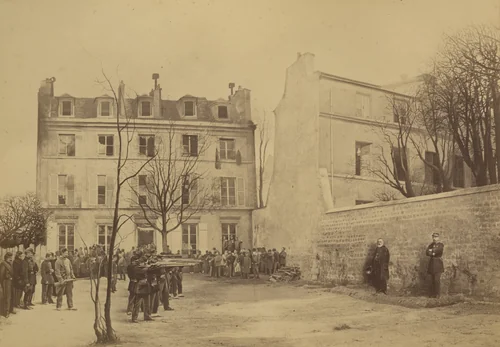
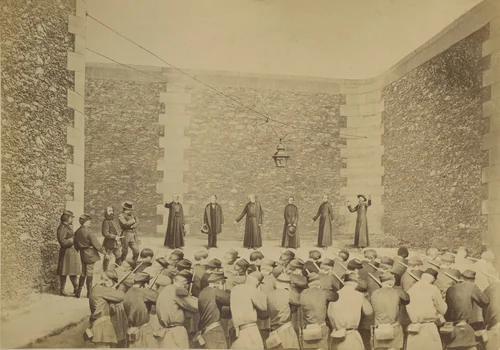
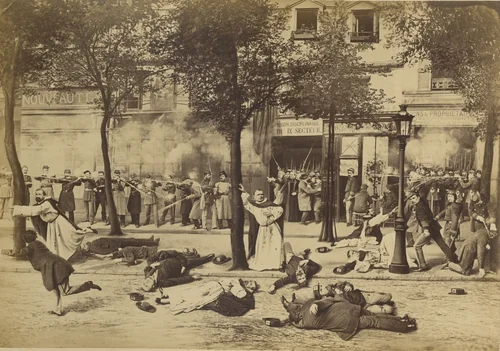
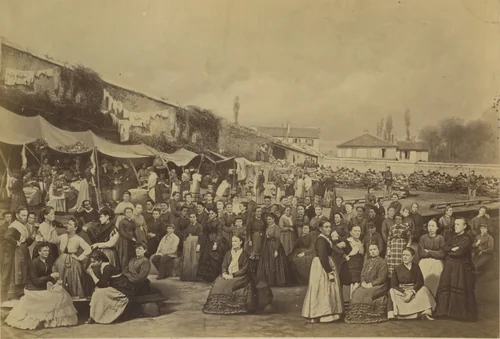
![[Recreations of the Fall of the Paris Commune, titled "Crimes de la Commune"] by Ernest Eugène Appert, book, 1870-1871](https://img.artbee.org/238c8aeb-1b9c-4479-830f-f60a5ba0bf74/small.webp)
![[Member of the Paris Commune: Angeline [Angelina Courcelles], cantinière, à perpétuité, pillage et incendie] by Ernest Eugène Appert, photograph, 1871](https://img.artbee.org/3f49eeba-8ea8-4c0d-838d-710b22fc79f5/small.webp)
![[Member of the Paris Commune: Augustine Prévost [Prévot], cantinière, à perpétuité, des fédérés] by Ernest Eugène Appert, photograph, 1871](https://img.artbee.org/9f88140b-41a6-42f4-8663-af4a174c19cc/small.webp)
![[Member of the Paris Commune: Hortense David, pointeuse à la Porte Maillot dans l’artillerie des fédérés, à perpétuité] by Ernest Eugène Appert, photograph, 1871](https://img.artbee.org/741d91e3-4e12-460b-b6e6-e8970a9ffee9/small.webp)
![[Member of the Paris Commune: Laure, cantinière, à perpétuité] by Ernest Eugène Appert, photograph, 1871](https://img.artbee.org/ab576c35-c78c-4d91-b063-768125416f7f/small.webp)
![[Member of the Paris Commune: Louise Bonenfant, cantinière et pointeuse dans l’artillerie des fédérés, à perpétuité] by Ernest Eugène Appert, photograph, 1871](https://img.artbee.org/03001d14-2742-40eb-83de-ebc2374e1c48/small.webp)
![[Member of the Paris Commune: Maria Menan, condamnée à mort, meurtre et incendie] by Ernest Eugène Appert, photograph, 1871](https://img.artbee.org/07b84da6-e22f-40d5-bdc8-44eb0d178d13/small.webp)
![[Member of the Paris Commune: Marie Chérel, perpétuité, pillage et incendie] by Ernest Eugène Appert, photograph, 1871](https://img.artbee.org/86f00190-b192-4bec-9fe3-55098791921a/small.webp)
![[Member of the Paris Commune: Marie Grivot, orateur de club, perpétuité] by Ernest Eugène Appert, photograph, 1871](https://img.artbee.org/00c066f2-3a5d-4a51-a98d-1a29b720e2d6/small.webp)