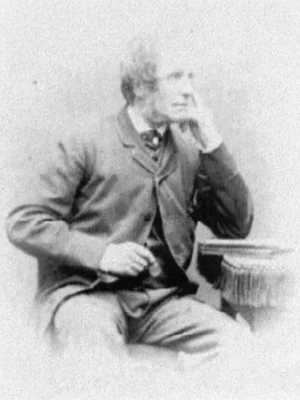
Edward William Cooke
Edward William Cooke (1811-1880) was a central figure in 19th-century British art, distinguished primarily as an English landscape and marine painter. Active from 1831 to the mid-1850s, Cooke established an enduring reputation through the meticulous, almost topographical precision he brought to depicting coastal scenes, nautical activity, and the dramatic interplay between sea and shore.
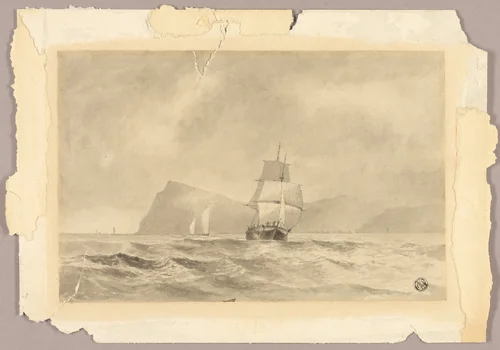
Unlike artists who relied on heavily romanticized interpretation, Cooke applied a rigorous observational discipline to his subjects. He was renowned for the accuracy of his ship rigging and the faithful rendering of light on water, making his works invaluable documents of maritime life during the Victorian era. This commitment to verisimilitude is evident in works that capture specific geographical moments, such as the evocative study Off Whitby and the exacting coastal charting visible in Rye - South Coast Near Hastings.
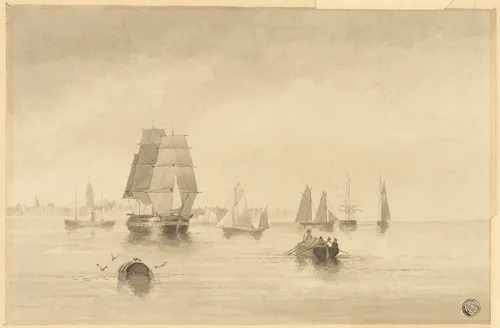
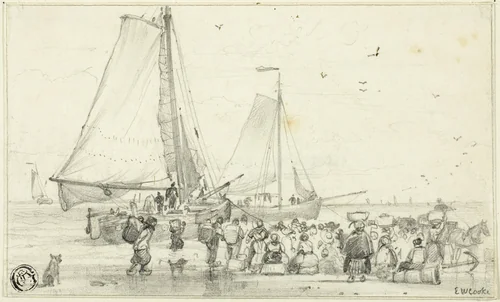
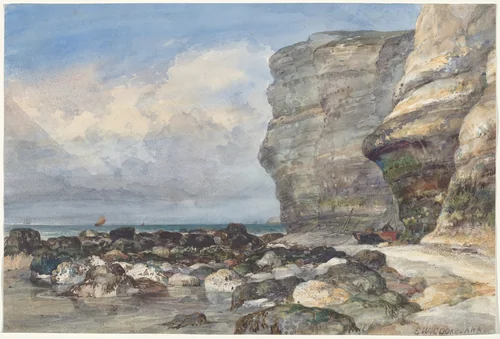
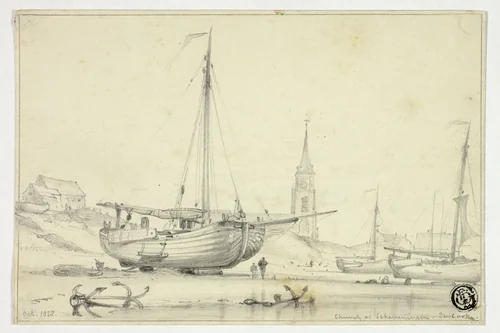
Cooke’s prolific output included detailed preparatory drawings and large-scale oil paintings. His subjects often focused on the vital, everyday labor of the sea, dynamically captured in pieces like The Catch Coming In. Though deeply rooted in British art, his travels broadened his pictorial scope, leading to works documenting continental coastlines and communities. His engagement with European sites yielded striking pieces such as Church at Scheveningen and The Rocky Beach and Cliffs at Fécamp, where he demonstrated mastery of geology and foreign light. These examples affirm the standing of Edward William Cooke paintings within the larger tradition of European marine art.
Cooke’s commitment to precision extended beyond the canvas; he was also a noted and highly dedicated gardener. This subtle but defining aspect of his life reveals an artistic mind driven by systematic classification and meticulous observation, whether applied to botanical arrangement or the complex mechanics of a vessel at sea.
Today, Cooke’s institutional legacy is secured by major collections, including the Art Institute of Chicago and the National Gallery of Art. Reflecting his sustained popularity and historical importance, many of his preparatory drawings and finished studies have entered the public domain. This accessibility allows researchers and collectors worldwide to study and enjoy downloadable artwork, including museum-quality high-quality prints of his definitive coastal scenes.
Source: Wikipedia · CC BY-SA 4.0