Edward John Poynter
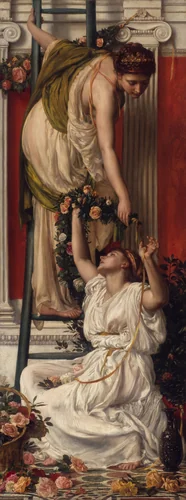
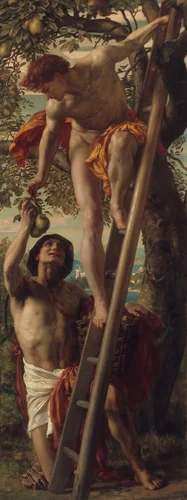
Sir Edward John Poynter, 1st Baronet (1836-1919), remains a critical, if sometimes underestimated, figure in the trajectory of Victorian and Edwardian art. Distinguished as a painter, designer, and skilled draughtsman, Poynter achieved the pinnacle of the British art establishment, serving as President of the Royal Academy, a post he held with rigorous conservatism. Educated through foundational study in Rome and Paris, he developed an exacting style rooted in classical composition and precise academic training, defining the standards for institutional taste well into the early twentieth century.
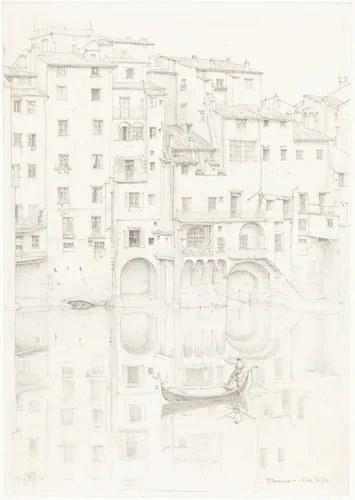
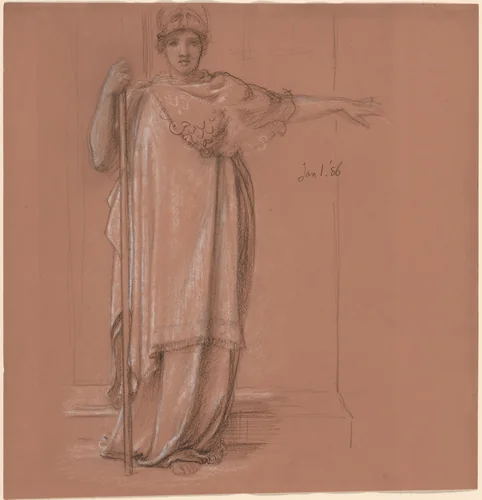
While Poynter is famed for his massive historical canvases, his early graphic output reveals the foundation of his technical mastery. His concentrated activity in drawing and printmaking during the 1860s emphasized linear clarity and detailed narrative rendering. This precision is documented in preparatory works such as Study of a Young Man's Head with Right Arm Outstretched, housed in major collections, including the Art Institute of Chicago.
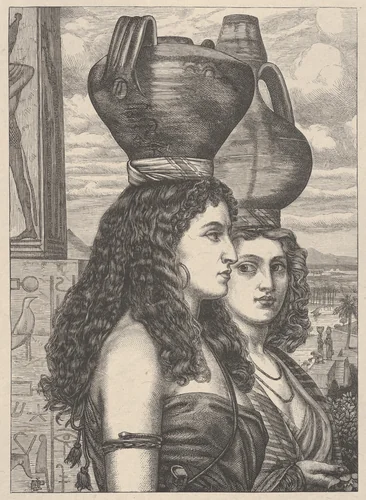
Poynter's illustrative contributions were particularly influential within the publishing industry. He furnished several powerful images for the celebrated Dalziels' Bible Gallery, providing dramatic interpretations of scripture that were widely disseminated through the medium of the wood engraving. Examples such as Moses Slaying the Egyptian and Moses and Aaron Before Pharoah set a standard for detailed, psychologically charged illustration. These Edward John Poynter prints demonstrate his commitment to making complex subjects accessible to a broad public.
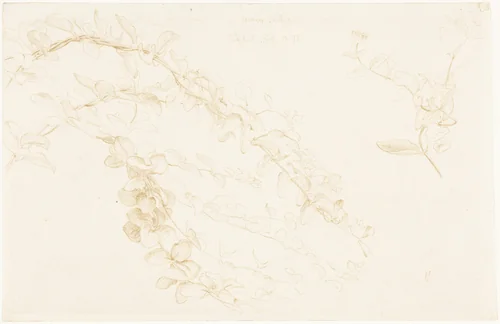
Poynter’s institutional control was absolute, establishing him as a powerful arbiter of taste. He was immensely hardworking, almost to a fault, a man whose sheer artistic productivity spanned over six decades of British history. His dedication to maintaining classical ideals, however, famously put him at odds with the rising tide of Post-Impressionism, an aesthetic revolution he struggled mightily to comprehend. Today, scholars and enthusiasts benefit from the widespread availability of his work; thanks to the status of his graphic output in the public domain, many of his drawings and original studies are now accessible as downloadable artwork through the major museum-quality collections that house his legacy.
Source: Wikipedia · CC BY-SA 4.0