Eduard Karsen
Johann Eduard Karsen (1860-1941) was a pivotal Dutch painter whose active period, roughly spanning 1870 to 1885, positioned him precisely at the transition point between 19th-century realism and the emotional subjectivity of early Modernism. Recognized today as a distinctive Post-Impressionist, Karsen rejected the often sun-drenched palette favored by earlier Hague School painters, preferring instead to render scenes of profound, often muted, introspection.
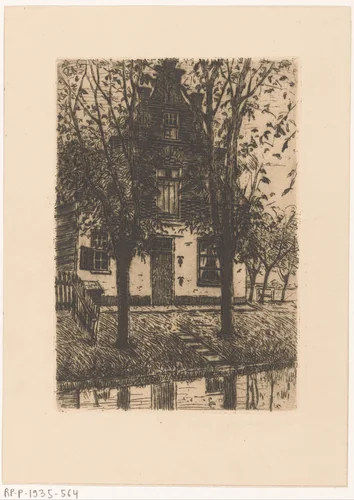
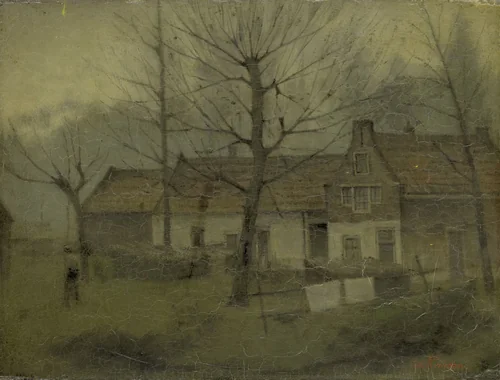
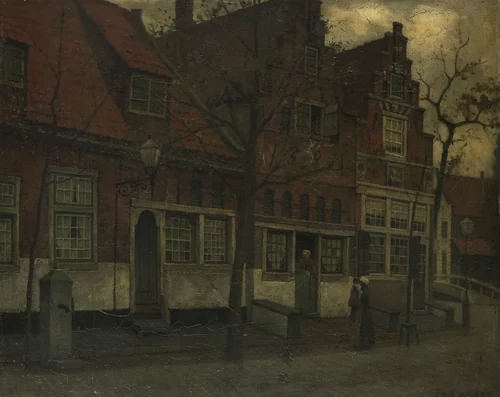
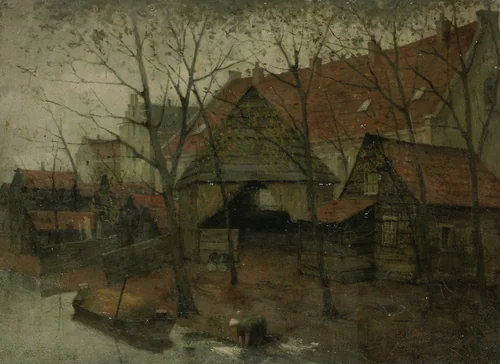
Karsen specialized in documenting the humble, quiet rural and urban peripheries of the Netherlands, focusing intently on simple architecture. Works such as Boerenhuis aan het water and Houses on the Breedstraat, Enkhuizen showcase his talent for turning simple topographical studies into complex emotional environments. His artistic signature was the creation of a heavy, often melancholy atmosphere, often achieved through restricted color harmonies. Unlike many of his contemporaries who sought the drama of the open sea or the bustling city, Karsen focused on enclosed, quiet spaces, usually incorporating a solitary figure. This insistence on isolation transforms the setting into a stage for psychological reflection, exemplified by the carefully rendered stillness in The Vinkenbuurt near Amsterdam.
Karsen’s artistic alignment extended beyond the canvas. He was closely associated with the literary collective known as the Tachtigers (the Eighties Movement), a group of writers who emphasized radical individualism and the philosophical principle of l'art pour l'art (art for art's sake). While the Tachtigers pursued revolutionary poetry, Karsen manifested their ethos through visual quietude, prioritizing atmosphere and mood over descriptive accuracy. A subtle and peculiar aspect of his small oeuvre is the remarkable consistency of tone; Karsen seemed determined to make every scene look as if it were perpetually ten minutes before a light rain.
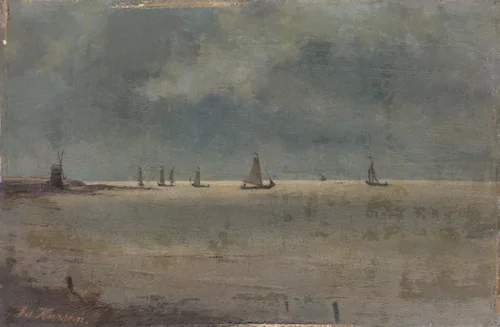
The scarcity of documented Eduard Karsen paintings, with major examples held in institutions like the Rijksmuseum, underscores their enduring importance. Today, reproductions of his work, including the study The Zuider Zee, are frequently available as high-quality prints through public domain initiatives, ensuring that these evocative compositions remain accessible for detailed study.
Source: Wikipedia · CC BY-SA 4.0