Eduard Gaertner
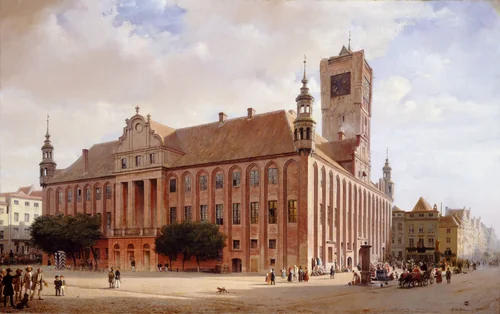
Johann Philipp Eduard Gaertner (1801–1877) was the preeminent German painter dedicated to capturing the rapidly evolving urban fabric of the nineteenth century, establishing himself as a master of the architectural veduta. Operating primarily during the Biedermeier period, Gaertner specialized in depictions of urban settings, becoming the foremost visual chronicler of Berlin’s modernization. His works are not merely accurate representations; they are insightful observations on the interplay between monumental civic structure and the routines of daily life.
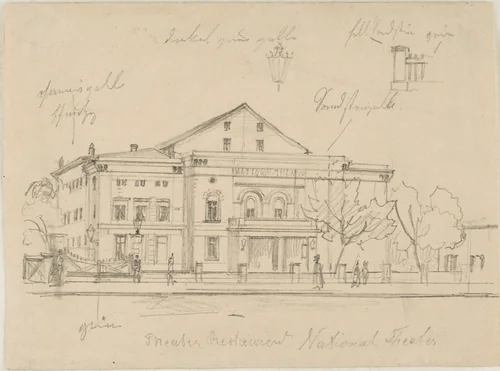
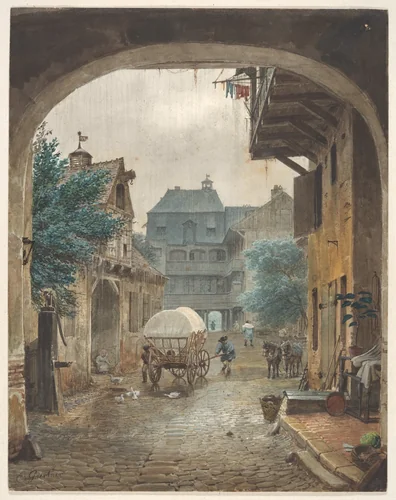
Gaertner’s stylistic innovation lay in the rigorous combination of topographical accuracy and atmospheric sensitivity, transforming pure documentation into compelling art. He began his process with highly detailed preparatory drawings, such as View into the Courtyard of an Inn at Colmar, before finalizing compositions as fully realized oil Eduard Gaertner paintings. This methodical approach allowed him to capture not just the static façade, but the subtle drama of light and shadow across the stone. Works like Study of the Nationaltheater, Berlin demonstrate his absolute command of linear perspective, giving his views an almost photographic fidelity while maintaining an evocative painterly quality.
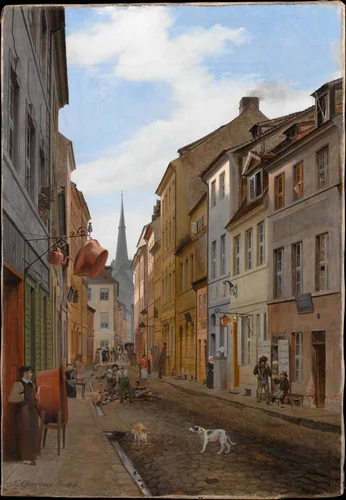
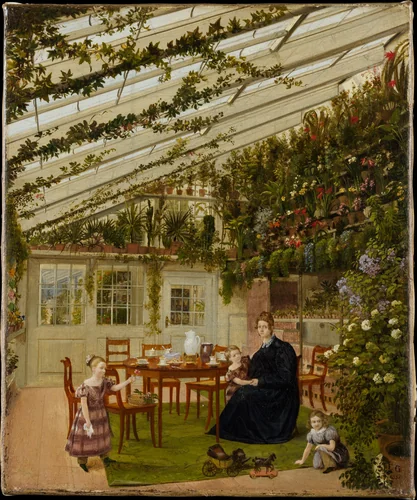
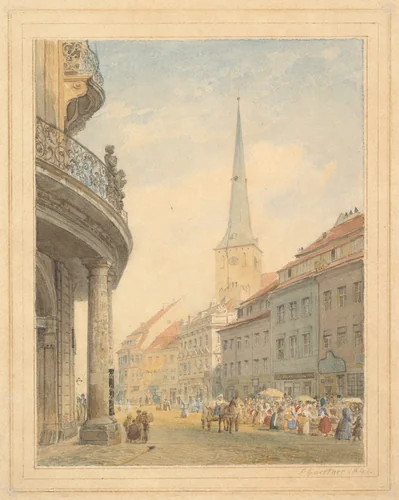
While celebrated for his expansive exterior vistas—the public squares and grand streets represented in works like Parochialstrasse in Berlin—Gaertner occasionally applied his precise spatial logic to intimate interior scenes. A rare and charming example is The Family of Mr. Westphal in the Conservatory, which uses the same rigorous compositional structure to map a private, domestic space, offering a delightful counterpoint to his civic documentation.
His lasting historical value is tied to his ability to freeze a moment in the life of a city, providing invaluable records of buildings that have since been altered or lost. Today, institutions such as the Metropolitan Museum of Art and the National Gallery of Art hold prime examples of his output. Much of his output is now in the public domain, ensuring that these remarkable documents of nineteenth-century Germany remain universally accessible as downloadable artwork for scholars and enthusiasts globally.
Source: Wikipedia · CC BY-SA 4.0