Dirck Stoop
Dirck Stoop (c. 1610-1651) holds a distinct, if often overlooked, position among the versatile artists of the Dutch Golden Age. Active as both a painter and, more significantly, an engraver, Stoop’s career was defined by exceptional mobility, a trait reflected in the multiplicity of his professional names, which included Dirck Stoff and Theodorus Stoop. When working on the Iberian Peninsula, he adopted the highly localized designation Rodrigo, a fascinating marker of the extent to which he adapted his identity to secure patronage across Europe.
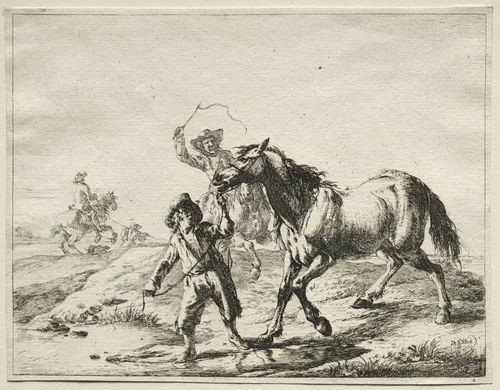
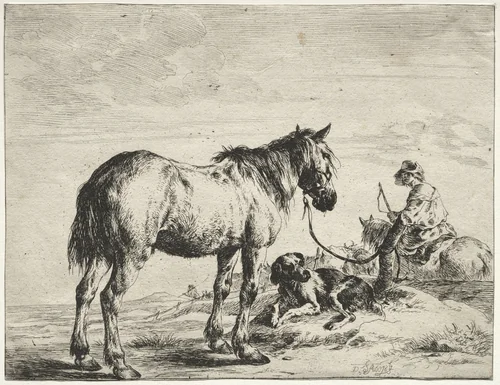
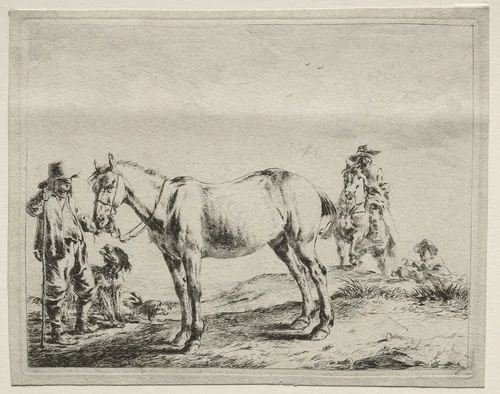
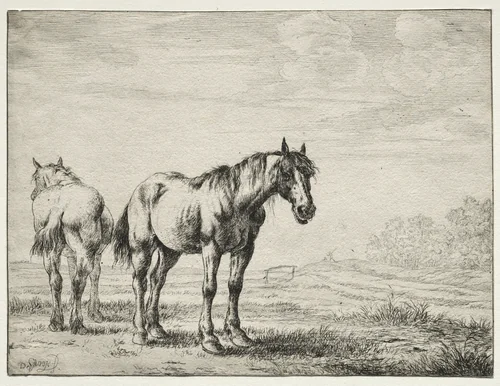
Stoop’s primary contribution lies in his printmaking, particularly his technically precise studies of equestrian subjects. His dedication to capturing the working musculature and behavioral nuances of horses elevated the genre study into something approaching scientific observation. He produced high-quality prints that documented the relationship between man and animal with a keen eye for detail. His major series, The Horses, illustrates this specialization, presenting animals in familiar, practical settings. Works such as Horse Bound to a Feeding Trough and Man Holding a Horse by the Bridle are exemplary in their use of sharp, confident line work to convey volume and texture.
The geographical breadth of Stoop’s work, which included periods in Portugal and possibly other centers of European culture, demonstrates the necessary adaptability of seventeenth-century artists driven by the search for commissions. Regardless of the signature he employed, Stoop maintained a consistent standard of technical excellence, securing his reputation among collectors who valued skilled draftsmanship.
Today, the durability of Stoop’s work is evident through its presence in major international collections, including the Metropolitan Museum of Art, the National Gallery of Art, and the Art Institute of Chicago. The detailed preparation required to create such museum-quality etchings has ensured the survival of numerous impressions. Owing to their age and historical importance, many of these influential Dirck Stoop prints are now categorized within the public domain, offering broad access to his highly specialized artistry.
Source: Wikipedia · CC BY-SA 4.0