Dieric Bouts
Dieric Bouts, also known historically as Dirk Bouts, holds a crucial position among the Early Netherlandish masters. Working primarily in Leuven from 1457 until his death in 1475, Bouts served as an essential conduit between the foundational achievements of the preceding generation and the subsequent flourishing of Northern Renaissance realism.
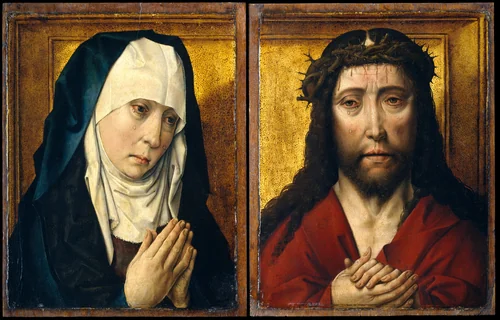
Bouts’s work is characterized by a precise synthesis of existing traditions. He is widely believed to have studied under or been heavily influenced by Rogier van der Weyden, from whom he inherited a dramatic intensity in figure work. Simultaneously, Bouts adopted the meticulous surface detailing and careful management of atmosphere pioneered by Jan van Eyck, resulting in compositions that feel profoundly still and meditative.
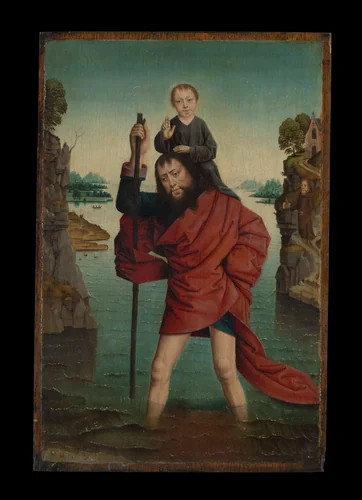
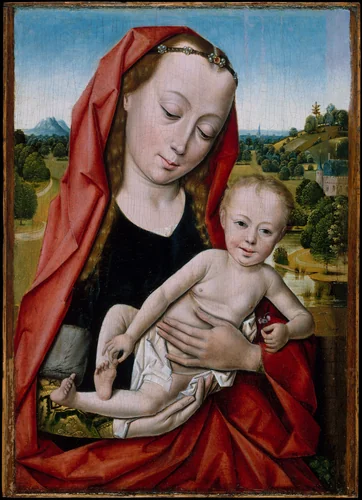
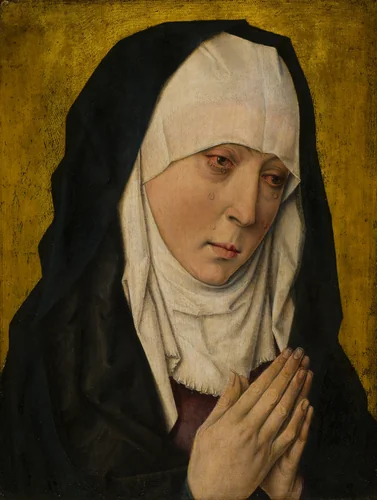
His contribution was particularly notable in the application of perspective. Bouts was an early experimentalist in the use of mathematically derived single-point perspective within the Netherlands. While his figures sometimes retained the charming, slightly elongated stiffness common to the era’s ongoing anatomical explorations, the background spaces in his Dieric Bouts paintings display a revolutionary commitment to geometric structure and depth. This technical innovation lent his religious subjects, such as Saint John the Baptist and Saint Christopher and the Infant Christ, an almost uncanny sense of spatial calm.
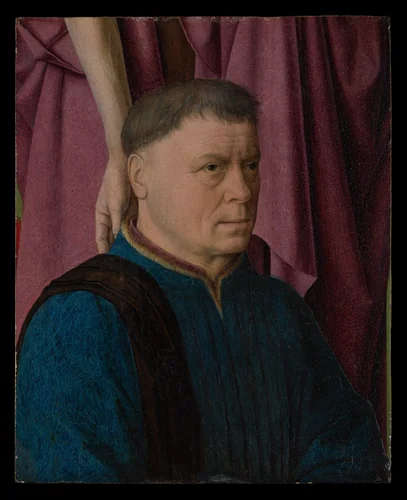
The artist’s specialized approach to portraiture, exemplified by his refined Portrait of a Man, also left a lasting impact. These works moved beyond simple likeness to establish a distinct psychological presence, often through a controlled application of light that emphasized the sitter’s gravitas. His surviving output, though limited, is highly prized and resides in major international collections, including the Art Institute of Chicago and the Metropolitan Museum of Art.
As the works of this masterful painter date to the fifteenth century and have long entered the public domain, Bouts’s delicate vision remains widely accessible. Researchers, collectors, and enthusiasts can readily obtain high-quality prints and reproductions of his celebrated pieces, ensuring that the legacy of Bouts’s authoritative and quiet realism endures centuries later.
Source: Wikipedia · CC BY-SA 4.0