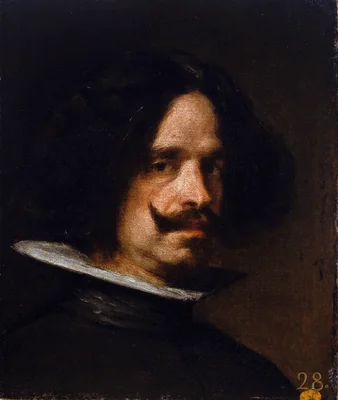
Diego Rodríguez de Silva y Velázquez
Diego Rodríguez de Silva y Velázquez (1599-1660) stands as the defining painter of the Spanish Golden Age and is universally recognized as one of the greatest artists in the history of Western art. His appointment in the 1620s as court painter to King Philip IV of Spain established his lifelong trajectory, transforming him from a successful Sevillian artist into the monarch’s privileged visual chronicler and official curator. Velázquez dedicated his career to the court, yet his innovative technique surpassed the formal expectations of his governmental role, yielding profoundly perceptive Diego Rodríguez de Silva y Velázquez paintings.
Velázquez was unmatched in his technical precision and optical naturalism, particularly his sophisticated handling of light, known as luminismo. He captured the psychological depth of his sitters with minimal flourish, prioritizing immediate presence and reality over idealized representation. His magisterial portrait of Philip IV (1605–1665), King of Spain, defines the somber, detached elegance of the Hapsburg monarchy. Conversely, works like the earlier devotional piece The Supper at Emmaus demonstrate his early mastery of shadow and drama, a precursor to the technical experimentation that would follow.
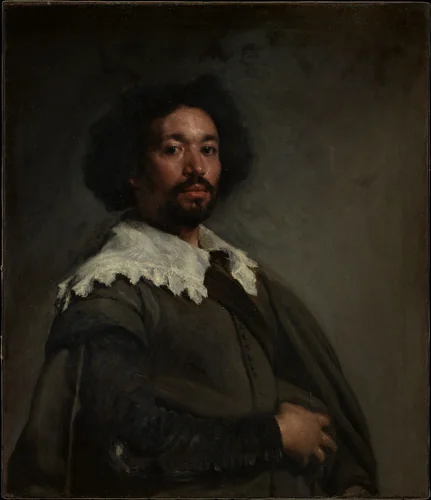
The height of Velázquez’s innovation is often seen in the work he produced during his Italian sojourns. The portrait Juan de Pareja (ca. 1608–1670), painted in Rome, showcases an astonishing freedom in brushwork and a compelling intimacy that transcends the subject’s status as the artist’s enslaved assistant. Unlike many of his contemporaries, Velázquez managed the demanding feat of being both a radically advanced painter and a highly-placed, pragmatic court official involved in the acquisition of museum-quality art and palace administration.
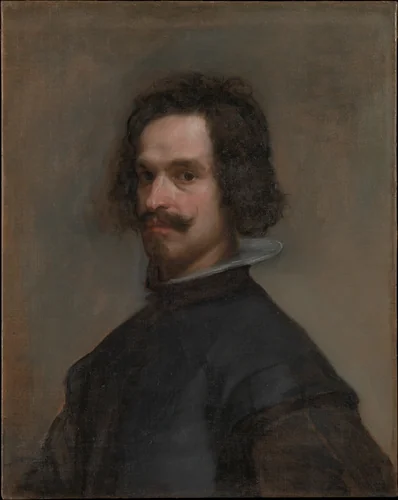
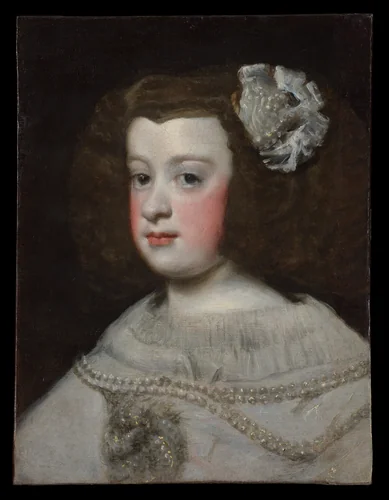
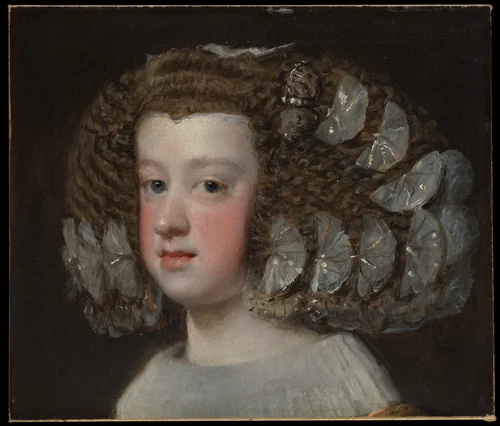
His database of works confirms the meticulous documentation of the Spanish court, including studies such as María Teresa, Infanta of Spain, which captures the rigid formality expected of royal children. Today, while masterpieces like those held in the Metropolitan Museum of Art remain crucial cornerstones of global collections, many of his striking images, including the intriguing Portrait of a Man, Possibly a Self-Portrait, have entered the public domain. This accessibility allows for the widespread distribution of high-quality prints and downloadable artwork, ensuring that the sheer technical audacity of Velázquez continues to shape and inspire the study of painting worldwide.
Source: Wikipedia · CC BY-SA 4.0