Diego Rivera
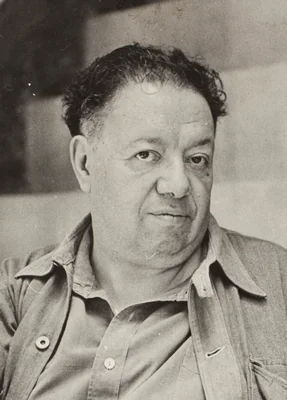
Diego María de la Concepción Juan Nepomuceno Estanislao de la Rivera y Barrientos Acosta y Rodríguez (1886-1957) was a monumental figure in twentieth-century art, a Mexican painter whose political commitments were expressed on an unprecedented, architectural scale. Rivera became internationally renowned for his monumental frescoes which successfully resurrected muralism as a powerful narrative form. These expansive public works were instrumental in establishing the Mexican mural movement, fundamentally redefining the relationship between social commentary and visual art for a global audience.
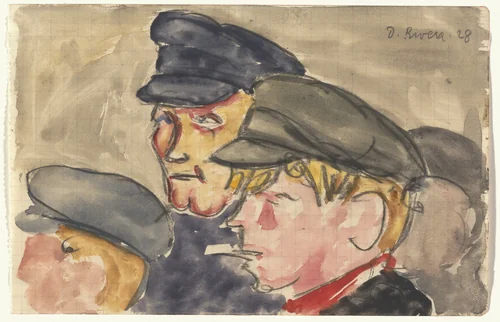
Active extensively between 1906 and 1927, Rivera spent formative years in Europe, particularly Paris, where he immersed himself in the avant-garde movements. He became a significant, if often overlooked, practitioner of Cubism, applying its geometric principles to both still life and portraiture. His works from this period, such as the focused study Young Man in a Gray Sweater (Jacques Lipchitz) and the fragmented organization of Cubist Landscape, demonstrate a deep technical command over composition and pictorial space, placing him firmly among the contemporary European modernists. His early drawings, including intimate studies of his partner, Angeline Beloff, further illuminate this crucial period of stylistic evolution.
The lasting significance of Rivera stems from his unwavering dedication to incorporating revolutionary ideals into public, accessible narratives. Upon his return to Mexico, he employed the techniques assimilated in Europe to depict Mexico’s history, pre-Columbian mythology, and the struggles of the working class. Although celebrated primarily for the large scale of his installations, his commitment to draftsmanship is evident in early canvases, such as the poignant Dead Horse.
Today, institutions like the Museum of Modern Art hold key examples of Diego Rivera paintings, providing crucial documentation of his shifts from European formalism to Mexican nationalism. Rivera’s ability to fuse modernist aesthetics with profound social commentary ensured that his narratives were instantly legible to the populace. It is perhaps fitting that an artist whose ambition required such immense public surfaces was given a name that demanded twenty-two syllables to pronounce in full. Many of his studies and sketches, including works like Day of the Dead in the Country, are now widely accessible, with various archives offering high-quality prints of the artwork for non-commercial research and appreciation.
Source: Wikipedia · CC BY-SA 4.0