Daniel Hopfer
Daniel Hopfer (active 1470-1490) holds a foundational, if historically underappreciated, position in the history of graphic arts, widely credited as the first artist to utilize etching for the creation of printed images. Working in Augsburg at the close of the fifteenth century, Hopfer revolutionized printmaking by adapting the acid-based technique, traditionally used to decorate armor, and applying it to iron printing plates. This transfer of the process from metalworking to artistic reproduction allowed for a new visual language, offering the artist the spontaneous freedom akin to drawing, distinct from the arduous mechanical labor required for traditional line engraving.
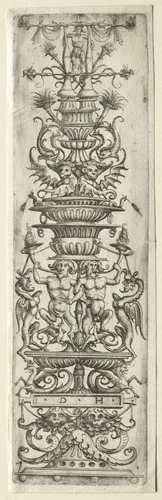
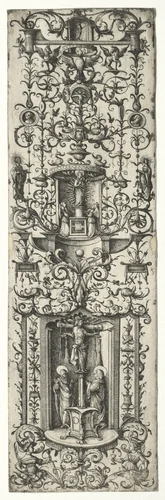
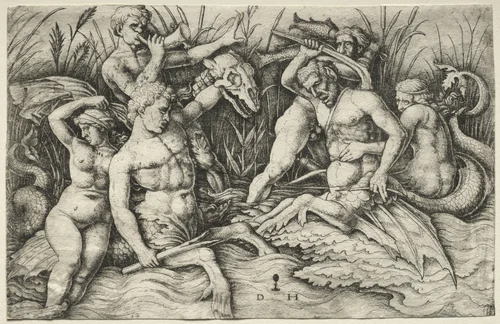
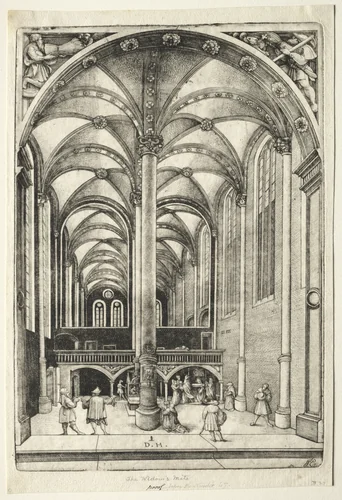
While Hopfer also practiced woodcut, his legacy rests primarily upon his pioneering etchings, a collection of roughly fifteen plates. His works span a remarkable breadth of subject matter, encompassing complex figural compositions like Girolamo da Siena and Three German Soldiers, alongside sophisticated ornamental designs, including the intricate Designs for Ten Decorative Friezes and the imaginative Candelabra Grotesque. His religious output, exemplified by IHS Monogram surrounded by Six Angels, showcases the fine detail achievable through this new technique.
For many years, the significance of Hopfer’s technical achievements was largely overlooked by historians focused on later masters of etching. However, recent critical scholarship has decisively affirmed his critical influence, recognizing him not only as a technical innovator but as a foundational figure in the commercial distribution of art. Scholars now credit him with "single-handedly establishing the salability of etchings" and introducing the model of the independent print publisher. It is a subtle irony that the artist who essentially invented the early modern art-distribution framework was himself forgotten by that same framework for centuries.
Today, the enduring artistic merit of Hopfer’s creations is evidenced by their presence in major institutions, including the Art Institute of Chicago and the Metropolitan Museum of Art. These museum-quality examples, crucial milestones in the development of printmaking, are increasingly available as downloadable artwork through public domain collections, ensuring that Daniel Hopfer prints remain accessible to contemporary audiences and scholars.
Source: Wikipedia · CC BY-SA 4.0