D. H. Burnham & Co.
D. H. Burnham and Company served as one of the most significant architectural and urban planning firms operating from Chicago during the turn of the 20th century. Formed as the successor practice following the death of architect John Root in 1891, the firm effectively consolidated power under Daniel Hudson Burnham. While Root had served as the chief consulting architect for the pivotal World's Columbian Exposition, Burnham quickly assumed this title alongside his previous role as Chief of Construction. This dual responsibility positioned the reorganized company at the epicenter of large-scale American design and commercial architecture, transforming it into a highly influential, centralized planning powerhouse.
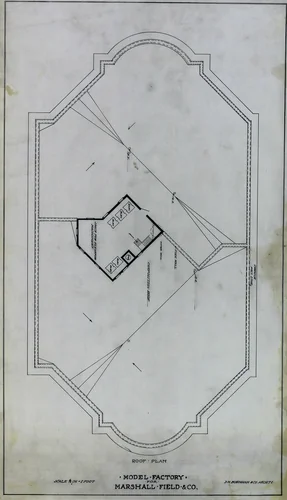
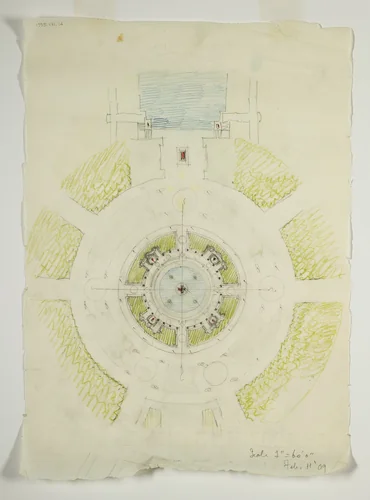
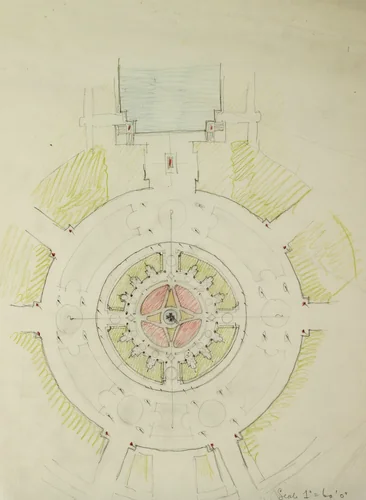
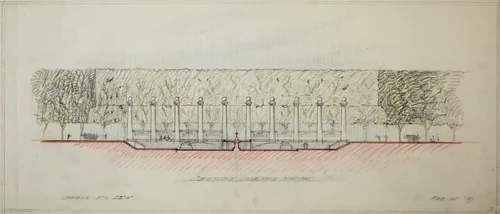
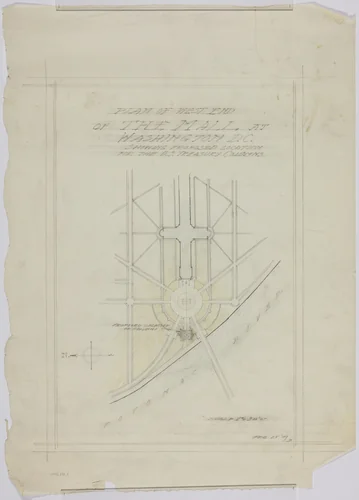
The firm’s output ranged from groundbreaking commercial skyscrapers to massive civic planning schemes, demonstrating a mastery of both detailed engineering and monumental scale. The surviving documents, active primarily between 1900 and 1909 and currently held in collections like the Art Institute of Chicago, illustrate this essential duality. On one hand, the Marshall Field & Company Model Factory, Chicago, Illinois, Roof Plan reveals the functional precision required for innovative industrial architecture, setting standards for efficiency and light. On the other, the elaborate series of sketches and plans for the Potomac Round Point in Washington D.C., including the detailed Circular Pool Plan Sketch and the Section Sketch, confirm the company’s deep commitment to the monumental classicism characteristic of the burgeoning City Beautiful movement.
The legacy of D. H. Burnham and Company extends far beyond individual structures; it is perhaps best embodied by Daniel Burnham's famed dictum, "Make no small plans," a philosophy that guided the redesign of entire metropolitan areas. The sheer scope of the firm’s ambition often overshadowed the work of its many talented associates, making D. H. Burnham & Co. less a traditional partnership and more a meticulously efficient engine for national design execution. Today, these historic architectural plans and elevations, which demonstrate unparalleled planning rigor, are frequently digitized. Many are now within the public domain, offering historians and admirers of early American modernism access to high-quality prints and downloadable artwork, ensuring that the firm's grand conceptions remain accessible for generations to study and appreciate.