Cornelis Kruseman
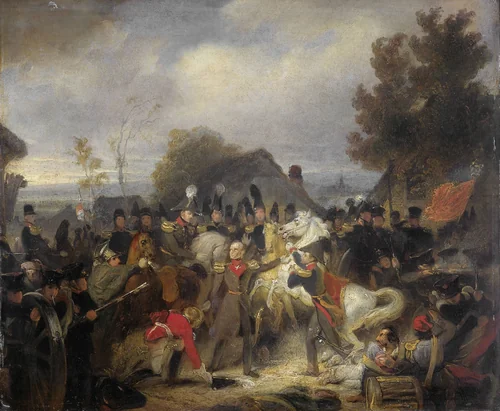
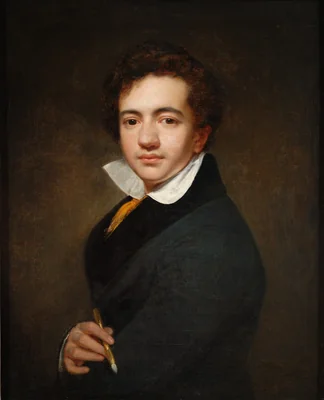
Cornelis Kruseman (1797-1857) established himself as one of the most technically comprehensive Dutch artists operating in the early decades of the nineteenth century. His active period, spanning 1807 to 1837, showcased a rare command over a spectrum of media seldom mastered by a single individual. Beyond his established reputation for Cornelis Kruseman paintings, he worked fluently as a skilled draughtsman, etcher, and lithographer.
Kruseman’s technical versatility was extraordinary. He synthesized traditional oil painting techniques with emerging graphic arts. Remarkably, his toolkit extended even to the demanding practices of silhouetting and paper-cutting, demonstrating an almost compulsive urge toward visual production, regardless of scale or permanence. His output therefore provides a valuable catalogue of the aesthetic concerns and technical possibilities available to Dutch artists transitioning between the Neoclassical ideal and the rising tide of Romanticism.
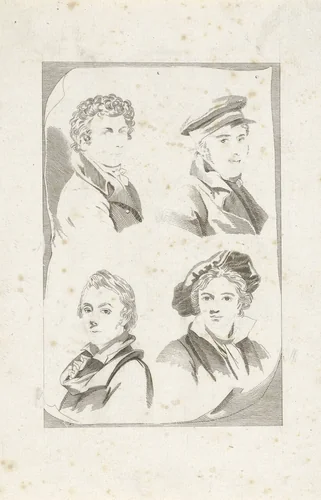
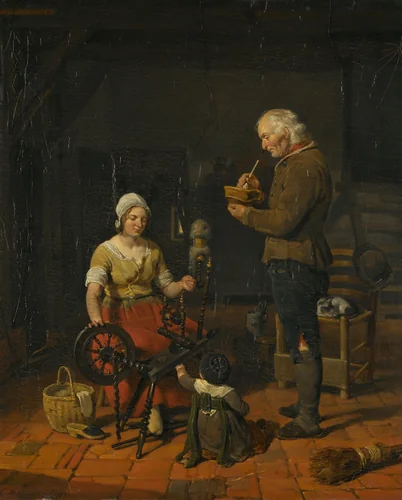
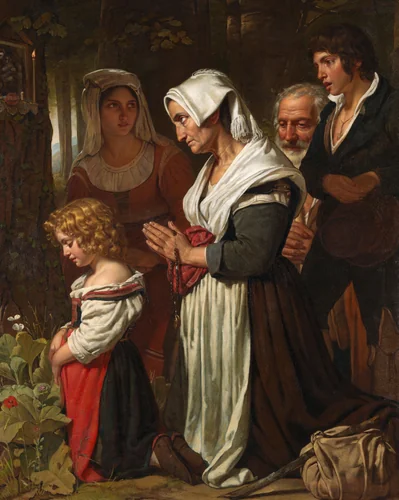
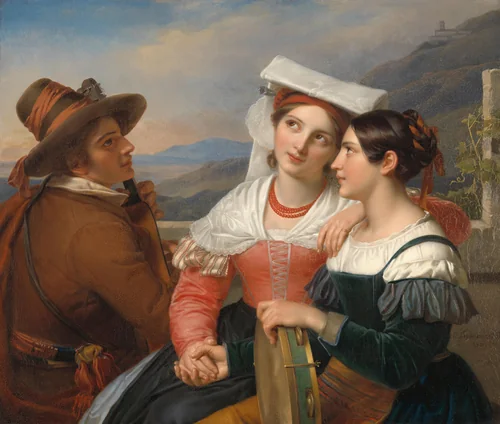
His thematic output centered on three primary pillars: commissioned portraiture, traditional biblical narratives, and, most famously, depictions of Italian peasant life. The four surviving Vier schildersportretten confirm his success in official artistic circles. However, it was his genre scenes, such as Peasant Family in their Cottage, that provided contemporary audiences with idealized yet intimate views of rural southern Europe, fulfilling a substantial demand within the market for picturesque costume pieces. Works like Of One Heart and the spiritual Godsvrucht further reveal his capacity for emotionally resonant narrative.
As an accomplished art collector himself, Kruseman possessed a keen eye for quality and permanence, traits reflected in the meticulous execution of his own oeuvre. His body of work, which includes both key paintings and important Cornelis Kruseman prints, is secured in major institutions, notably the Rijksmuseum, ensuring its status as museum-quality material for ongoing study. Today, the enduring value of his artistic documentation is enhanced by its availability; many of his significant works have entered the public domain, allowing for their reproduction as high-quality prints and downloadable artwork accessible globally. This widespread accessibility attests to the fundamental and enduring regard held for his substantial technical skill.
Source: Wikipedia · CC BY-SA 4.0