Claudine Bouzonnet-Stella
Claudine Bouzonnet-Stella (1636-1697) was a distinguished French engraver whose focused and potent career spanned the heart of the mid-seventeenth century. Operating at the vital nexus where classical painting met the emerging mass market for prints, she became instrumental in disseminating the core tenets of French classicism to a broad European audience.
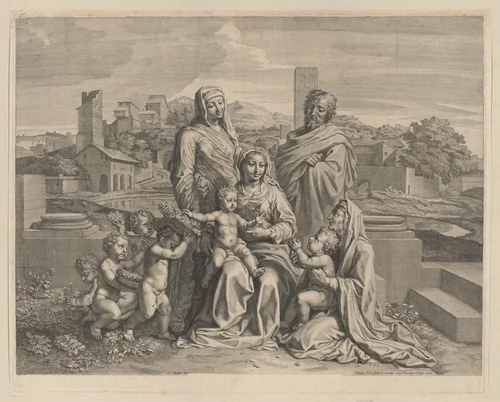
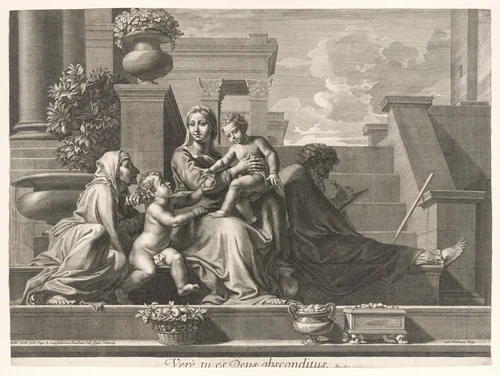
Trained under the supervision of her uncle, the painter Jacques Stella, Bouzonnet-Stella honed a technical precision in line and composition that allowed her to effectively translate complex oil paintings into the medium of engraving. Her catalogue of approximately fifteen known prints, produced largely between 1650 and 1667, derives almost exclusively from the compositions of her relative, Stella, and the era’s foremost intellectual painter, Nicolas Poussin. This specialization established her as a master interpreter, ensuring that the monumental works of these figures were made available as high-quality prints for study and private collection.
Bouzonnet-Stella displayed significant versatility across subject matter. Her religious output included dramatic narratives such as Jesus Wrapped in the Robe of Fools, plate 12 from The Passion of Christ, showcasing her handling of weighty devotional themes. However, she is also highly regarded for her ability to capture scenes of quotidian life. Her suite of genre etchings known as Pastorales elevates commonplace activities through a classical sensibility, evident in plates such as A Game of Boule and Country Meal. These scenes apply the strictures of classical composition to rustic settings, resulting in images that possess both charming immediacy and formal structure.
While Claudine Bouzonnet-Stella created no original paintings, her critical role as a meticulous translator and facilitator of masterpieces secured her own lasting reputation. It is a subtle irony that her enduring fame stems entirely from her technical prowess in faithfully rendering the inventions of others. Today, these significant works are held in major global institutions, including the Metropolitan Museum of Art and the Art Institute of Chicago, affirming their museum-quality status. Many of her designs are now widely accessible in the public domain, allowing scholars and enthusiasts alike to engage directly with the exacting standards of mid-seventeenth-century French printmaking.
Source: Wikipedia · CC BY-SA 4.0