Christiaan Andriessen
Christiaan Andriessen (1775-1846) occupies a distinct position in the history of Dutch draftsmanship, documenting the social and architectural landscape of Amsterdam during the politically volatile transition from the late eighteenth century into the French-Bataafsch period. Born and trained in Amsterdam as the son and student of the established artist Jurriaan Andriessen, Christiaan’s proficiency spanned across history painting, genre subjects, town views, and portraiture. His active period, roughly 1784 to 1833, coincided with an era of profound cultural reorientation, which he chronicled with notable diligence.
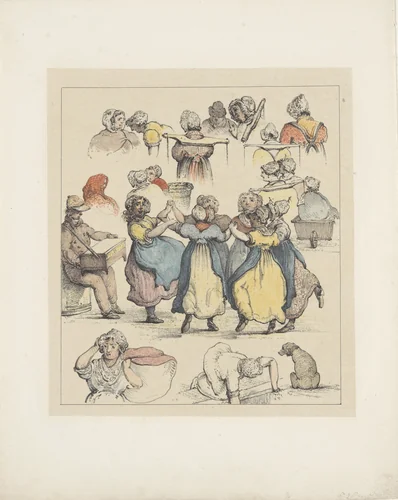
Andriessen was a highly versatile practitioner, yet his lasting contribution lies in his meticulous documentation of contemporary life and urban topography. He is remembered for major undertakings, including his widely recognized Panorama of Amsterdam. His surviving output, represented in major collections like the Rijksmuseum, includes twelve known drawings and three prints, which frequently blend architectural precision with candid genre observation. These works capture everything from grand social gatherings to intimate domestic scenes, providing invaluable visual context for the era.
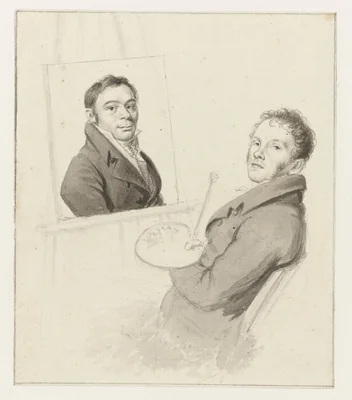
The diary-like captions accompanying several of his significant works emphasize this focus on temporal documentation. Drawings such as 't Fransch-Bataafsch Museum bezigtigt (May 24) and Bal masqué in de Zwanenburgerstraat (March 26) detail the evolving cultural and social rituals of the city. While capable of serious historical composition, Andriessen had a keen eye for the smaller social absurdities of the day, evidenced by the slightly chaotic energy of works like Een heerlijke mis (January 4, 1808) or the gentle humor implicit in 't Compliment van Katrijn (December 10). These scenes, often executed with the refined technique of his Interieur met twee mannen waaronder een tekenaar, showcase his ability to elevate everyday moments to museum-quality artifacts.
Today, Christiaan Andriessen prints and drawings are foundational elements for understanding the socio-cultural texture of the early Dutch nineteenth century. Thanks to the accessibility of his surviving graphic works, many of which now reside in the public domain, researchers and enthusiasts can study his output through high-quality reproductions. Andriessen’s legacy rests not only on his technical skill as a painter but also on his detailed, lively visual record of his changing nation.
Source: Wikipedia · CC BY-SA 4.0