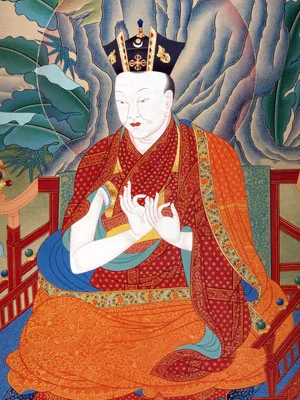
Choying Dorje
Chöying Dorje (1604–1674), the Tenth Karmapa and spiritual head of the Kagyu school of Tibetan Buddhism, stands as one of the most significant and independent artistic innovators of the seventeenth century. His importance extends beyond his profound theological duties, rooted in his fundamental challenge to the prevailing stylistic conventions of Tibetan thangka painting and sculpture, fostering a unique synthesis of spiritual authority and aesthetic experimentation.
Active during a period of immense political and religious upheaval in Tibet, the Karmapa’s artistic output is characterized by a definitive departure from the rigid, formalized artistic traditions that had dominated for centuries. He rejected the established, conservative aesthetics often reliant on distant Chinese court models, instead favoring a unique, expressive naturalism. His works employ fluid, dynamic lines, highly personalized anatomical detail, and a vibrant color palette, often demonstrating an unexpected familiarity with external visual lexicons, including the lively, naturalistic aesthetic found in Mughal art from the Indian subcontinent.
This willingness to integrate diverse global influences into sacred art revolutionized the concept of Tibetan devotional imagery. Unlike many contemporaries who relied strictly on large monastic workshops to produce standardized iconography, Chöying Dorje frequently acted as both patron and sole artisan, crafting pieces entirely by his own hand. This deep, personal engagement with materials, particularly evident in his surviving bronze sculptures, imbued his creations with a singular sense of immediacy and expressive power often missing in mass-produced objects. It is perhaps one of history’s more delightful artistic paradoxes that a figure so central to religious institutional authority possessed such a deeply radical and independent personal vision.
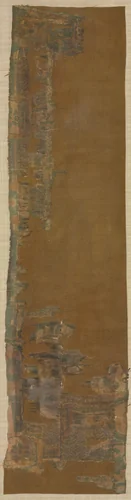
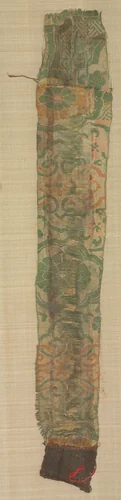
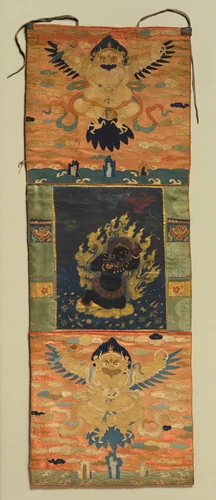
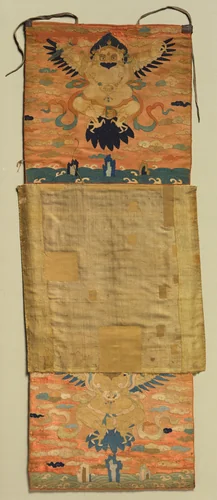
Though much of his political life was spent either in exile or navigating severe instability, his artistic legacy endured, disseminating his bold new style and influencing subsequent generations of monastic artists. His extraordinary Choying Dorje paintings and sculptures are now preserved in major international collections, where the technical mastery required for these museum-quality pieces can be fully appreciated. Increasingly, high-resolution photographs of his drawings and designs are made available as downloadable artwork for scholarly study and public access.
Source: Wikipedia · CC BY-SA 4.0