Chokha
Chokha stands as one of the essential figures of the Mewar painting tradition, whose prolific career spanned the reigns of two distinct Maharanas: Jagat Singh II (r. 1734–51) and Bhim Singh (r. 1778–1828). Active from approximately 1725 to 1810, his sustained tenure provided an invaluable artistic record of court life during a period of complex political and cultural evolution in Rajasthan. His enduring significance is evidenced today by major institutional holdings, including the Metropolitan Museum of Art and the Cleveland Museum of Art, where Chokha paintings are recognized as museum-quality examples of the Mewar style.
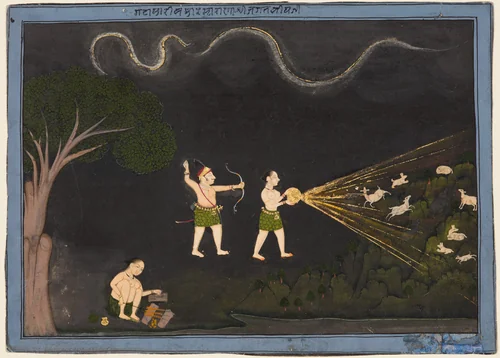
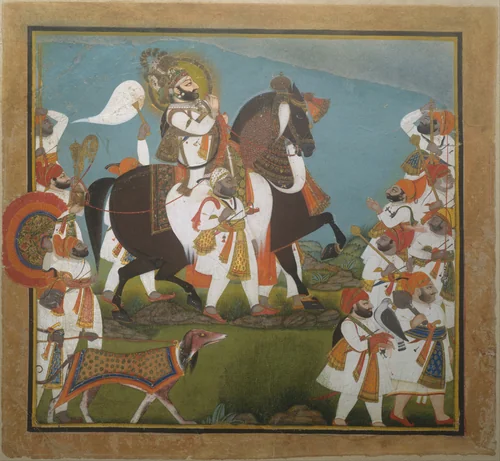
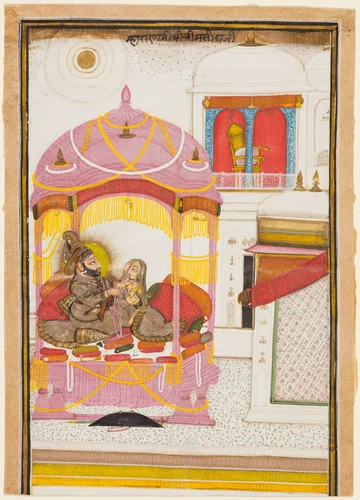
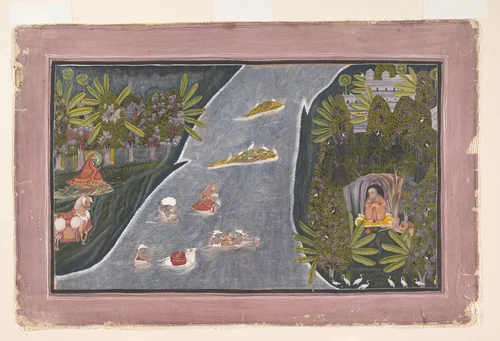
Chokha excelled in portraiture and the dramatic staging of the royal hunt, or shikhar. His commissions frequently focused on documenting the prowess and specific rituals of the ruler, as demonstrated in masterpieces such as Maharana Jagat Singh II of Mewar (r. 1734–51) Dressed as a Bhil, Hunting Deer at Night. This painting, a triumph of atmospheric control, showcases Chokha’s highly sophisticated technical mastery in rendering nocturnal scenes. His ability to manipulate light and shadow while retaining meticulous detail within dynamic compositions sets his work apart from many contemporaries. This flair for spectacle continued into his later career under Bhim Singh, captured vibrantly in works like Maharana Bhim Singh and Retinue Embark on a Hunt, where the energy of the retinue and the density of the landscape are meticulously balanced.
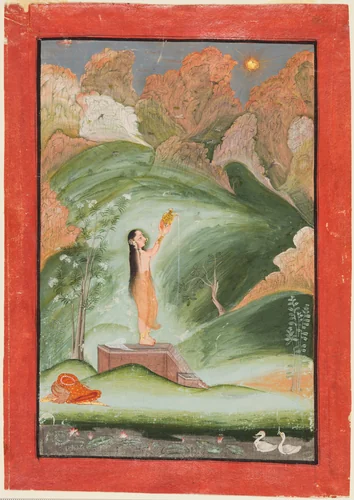
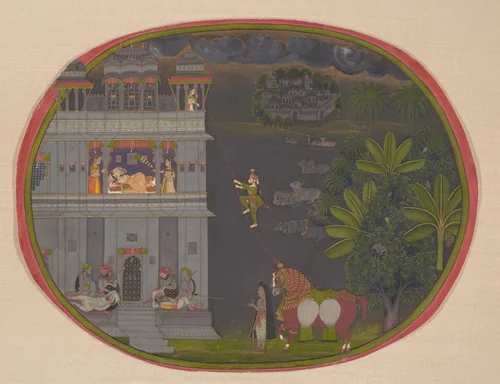
Beyond the grand public stage, Chokha also proved adept at capturing the private or devotional aspects of court life. His output includes more intimate studies, such as A girl worshipping the rising sun (Surya puja), which reveals a gentle command of domestic and religious themes often overlooked in grander court records. Furthermore, the tantalizingly titled Escapade at Night suggests an artist keenly attuned to the covert activities and secrets of the palace complex; a rare glimpse into a more complex social reality beneath the ceremonial surface.
Chokha’s longevity and stylistic consistency ensured that the late-eighteenth-century visual lexicon of Mewar remained both rich in detail and emotionally resonant. His contribution extended far beyond mere documentation, establishing a visual standard for the heroic and the personal. Today, the detailed execution and historical importance of Chokha prints and paintings make his work highly sought after, with many images now available as downloadable artwork for scholarly study and appreciation.
Source: Wikipedia · CC BY-SA 4.0