Charles Vernier
Charles Vernier was a significant contributor to the vibrant Parisian culture of satirical lithography during the mid-nineteenth century. Active primarily between 1840 and 1851, his work chronicled the escalating absurdities of social fashion and political manners prevalent during the July Monarchy and the ensuing Second Republic. His astute observations, characterized by biting wit and exceptional technical precision, secured him a place in major institutional holdings, including the Art Institute of Chicago, the National Gallery of Art, and the Cleveland Museum of Art.
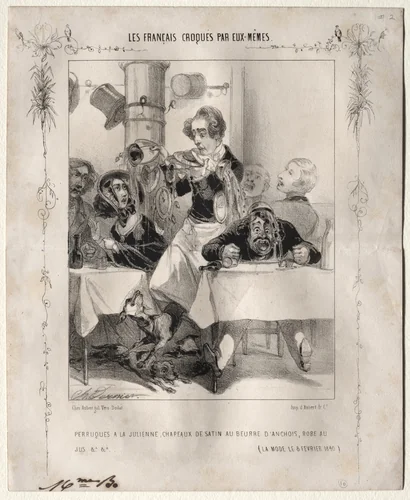
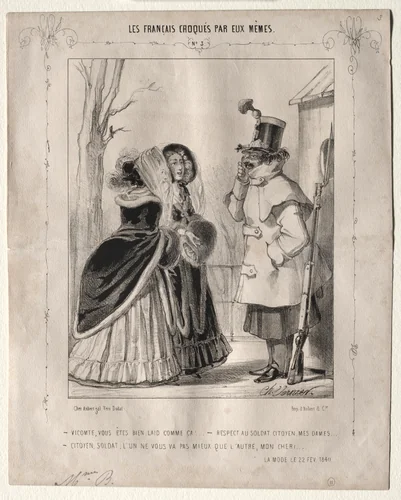
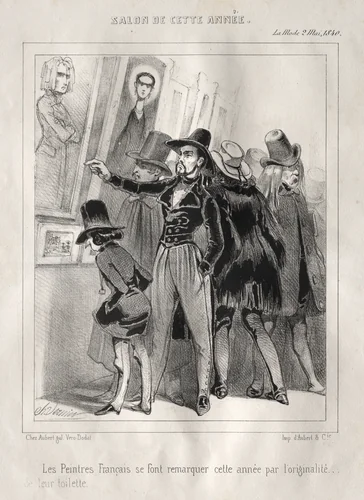
Vernier’s métier was the croquis, or quick sketch, elevated into complex visual commentaries that dissected contemporary pretension. His multi-plate series, Les Français croquès par eux-mêmes (The French Sketched by Themselves), offers perhaps the most detailed record of Parisian society’s foibles. In plates documenting the extremes of hairdressing and attire, such as Perruques a la Julienne, Chapeaux de satin au beurre d'anchois, robe au jus, Vernier captured the essential tension between rising bourgeois ambition and lingering aristocratic affectation. This social critique extended to the volatile political arena, evidenced by the cutting dialogue featured in the plate Vicomte, vous êtes bien laid comme ca!,,,Respect au soldat citoyen, mes dames...Citoyen, soldat, l'un ne vous va pas mieux que l'autre, mon cher!
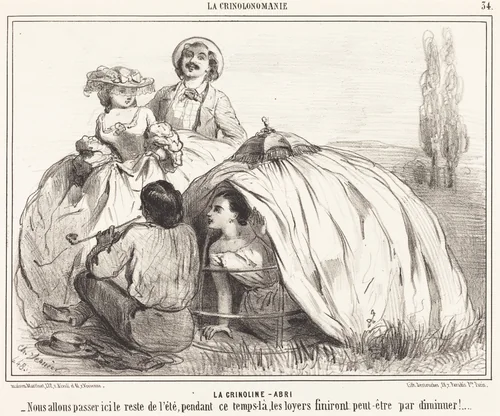
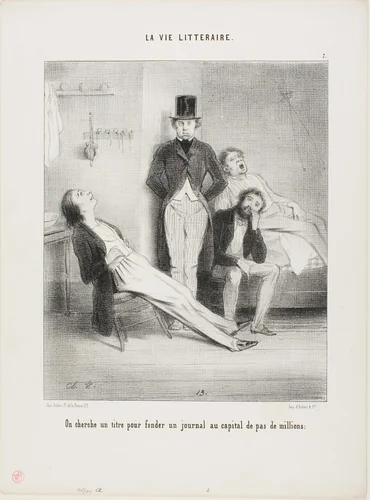
Vernier specialized in exaggerating the impracticality of contemporary fashion, a tendency perfectly encapsulated in the famous La Crinoline-Abri (The Crinoline-Shelter), a marvelous demonstration of how the expansive female silhouette functioned less as clothing and more as mobile architecture. His artistic method often employed dual-media commentary, pairing sharp visual satire with extended, theatrical captions, notably evident in The Literary Life, which offered insight into the emerging professional class of authors.
The popularity of lithography allowed these Charles Vernier prints to reach a wide audience, cementing his role alongside contemporaries who utilized the printed page to critique society. These visual records are distinguished by their precise line work and dry, observational humor. Though his active career saw rapid transformations in artistic styles, Vernier remained dedicated to this realist-satirical form, ensuring that his works maintain relevance as historical documents. As these important works increasingly enter the public domain, they become available globally as high-quality prints, allowing modern viewers direct access to the social complexities that shaped mid-19th century France.