Charles Thurston Thompson
Charles Thurston Thompson (1816–1868) holds a significant, if often overlooked, place among the pioneering figures of early British photography. Active during the medium’s pivotal foundational years, Thompson focused his technical mastery not on traditional portraiture or landscape, but on the precise, highly focused documentation of architecture and the decorative arts. This commitment elevated his work beyond mere cataloging, establishing a compelling early aesthetic standard for the photographic study of material culture.
Thompson’s primary professional activity centered around the mid-1850s, a crucial transitional moment when technical advances allowed for the high-resolution detail necessary to capture complex surfaces and elaborate craftsmanship. His surviving corpus demonstrates a remarkable capacity to manage the challenges inherent in early exposure times, transforming intricate objects into formally robust two-dimensional studies.
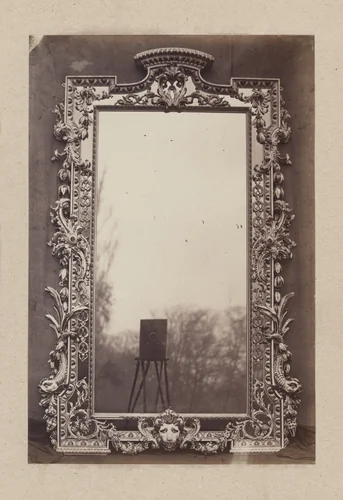
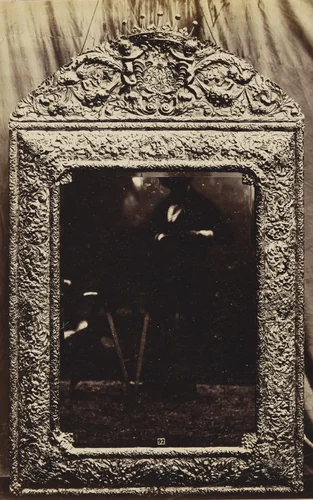
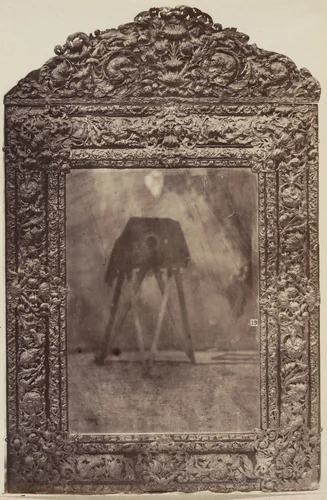
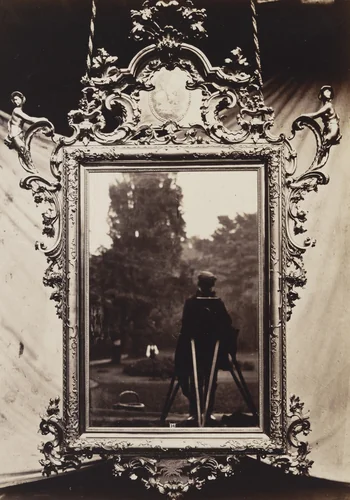
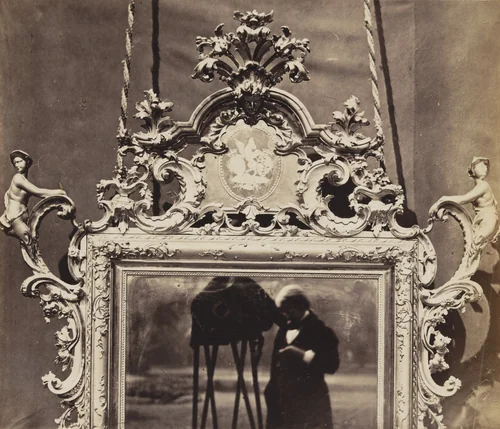
A key body of his work involves a series dedicated to documenting historically significant mirrors and furniture housed in British aristocratic collections. Images such as English Mirror, c. 1730, from Cumberland Lodge, Windsor Forest and the majestic Mirror from the King's Bedroom, Knole House, Kent serve as both invaluable art historical records and early photographic still lifes. In capturing highly reflective silver repoussé and Venetian glass, Thompson managed a notoriously difficult subject. It takes a certain unflappable dedication to early photochemical processes when your primary subject is designed specifically to throw light back at the camera. Thompson mastered this inherent complication, defining depth and texture through subtle shifts in lighting and careful composition.
Though Thompson did not produce Charles Thurston Thompson paintings, the historical and artistic merit of his photographic work is undeniable, resulting in their inclusion in major institutional holdings including the National Gallery of Art and the Metropolitan Museum of Art. His studies are recognized today as museum-quality examples of early photographic documentation. Furthermore, the longevity of Thompson’s contribution is ensured by the fact that many of his key works have entered the public domain, making high-quality prints and downloadable artwork accessible for ongoing scholarly research and appreciation worldwide.
Source: Wikipedia · CC BY-SA 4.0