Charles Reuben Ryley
Charles Reuben Ryley (c. 1752-1798) was an English painter and designer active during the latter half of the eighteenth century. Though biographical documentation remains relatively sparse, Ryley’s significance within the history of British draftsmanship is firmly established by the presence of his surviving works in leading institutional collections, including the Art Institute of Chicago and the Metropolitan Museum of Art. His relatively short known active period, spanning roughly 1772 to 1788, yielded compelling examples across painting, finished drawing, and especially the influential medium of printmaking.
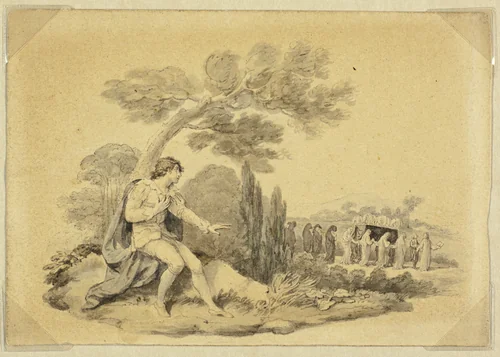
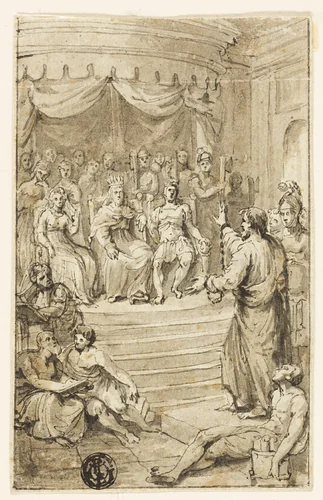
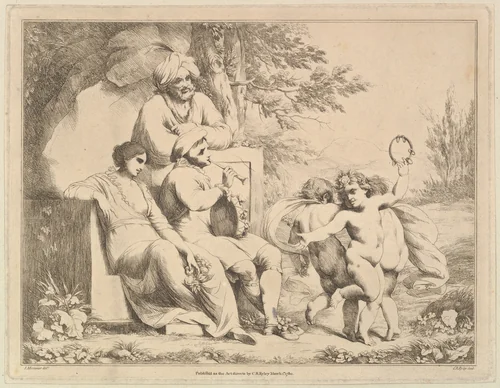
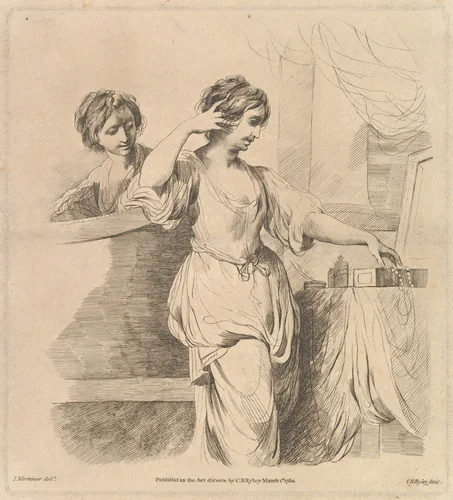
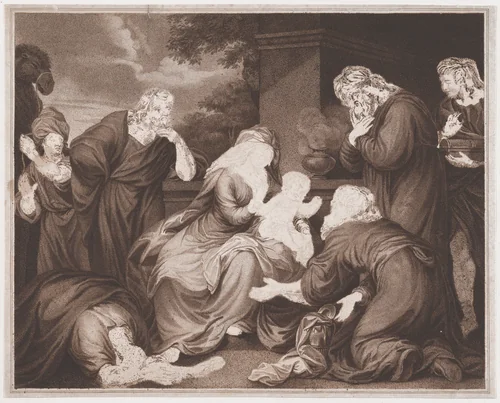
Ryley demonstrated facility across divergent subject matter, moving fluidly between elevated themes and decorative genres. His output includes serious biblical narratives, exemplified by the compositions Paul Before Festus and Agrippa and The Wise Men's Offering, suggesting an early specialization in historical painting. Concurrently, he produced intimate and allegorical genre studies. Pieces like Each Moment Has Its Sickle blend classical reference with moralizing genre, illustrating the late eighteenth-century taste for transferable moral lessons in art, while the finished drawing Woman at Her Toilet offers a highly detailed view of fashionable domestic life. Conversely, works such as the etching Three Putti Dancing to a Piper reveal a decorative Rococo sensibility, connecting Ryley to the thriving market for reproducible designs.
It is a fascinating nuance of his career that Ryley, primarily identified as a painter, is perhaps best remembered today for his transferable designs, which circulated widely as high-quality prints. This suggests that his artistic influence was distributed more broadly through commercial channels than his limited number of extant Charles Reuben Ryley paintings might imply. Considering his short working life, the surviving output offers a rich, if brief, glimpse into the varied commercial pressures and diverse artistic tastes of Georgian England. Today, much of his original design work has entered the public domain, allowing institutions and enthusiasts globally to access and appreciate these museum-quality works, often available as downloadable artwork for study.
Source: Wikipedia · CC BY-SA 4.0