Charles Parsons
Charles Parsons (active 1853-1869) was a meticulous American printmaker whose compact oeuvre provides an invaluable visual record of the technological ambition and commercial dynamism of the mid-nineteenth century. Though only approximately ten works are securely attributed to him, the significance of these high-quality prints is attested to by their inclusion in major institutional holdings, including the Metropolitan Museum of Art and the National Gallery of Art.
Parsons distinguished himself by documenting the apex of American industrial and maritime achievement, often focusing on subjects that were celebrated locally as symbols of national prestige and engineering prowess. He had a clear affinity for measuring and recording velocity; his chosen subjects were invariably the fastest, largest, or most modern innovations of the era.
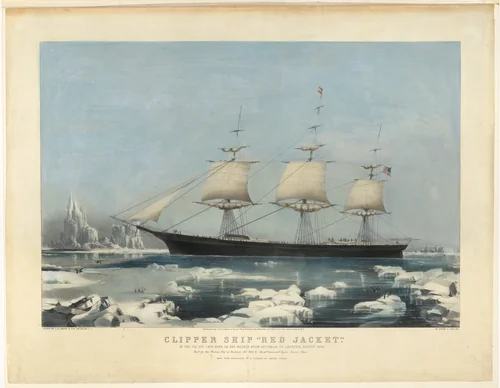
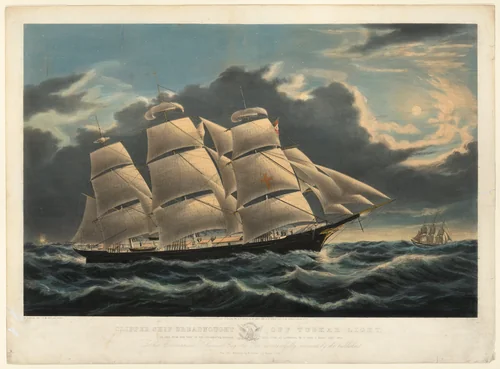
This focus is clearest in his maritime commissions. Prints like Clipper Ship "Red Jacket" – In the Ice off Cape Horn, on Her Passage from Australia, to Liverpool, August 1854 and Clipper Ship "Dreadnought" off Tuskar Light meticulously capture these vessels not just as ships, but as embodiments of record-breaking speed. The latter celebrates the Dreadnought’s famous passage into Liverpool in just 13 days and 11 hours, illustrating how Parsons acted as a visual chronicler of international trade competition.
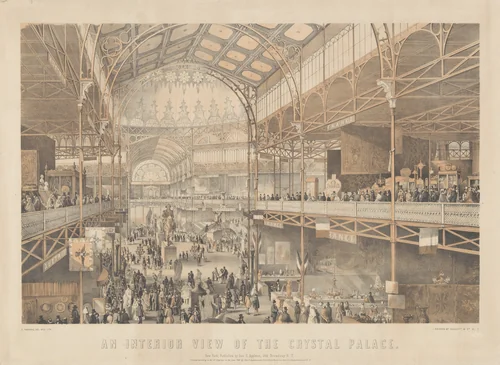
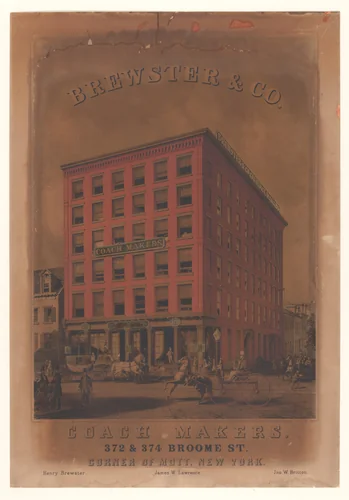
Beyond the ocean, Parsons cataloged the urban landscape of New York City undergoing profound modernization. His work ranged from capturing the grandeur of temporary architectural spectacles, such as An Interior View of the New York Crystal Palace, to precise industrial documentation, exemplified by Brewster & Co. Coach Makers, 372 & 374 Broome St. These compositions serve as vital primary documents for historians studying nineteenth-century commercial architecture and manufacturing processes. The enduring detail and historical accuracy of his work ensure that Parsons’ legacy persists, with many compositions now available through public domain collections as museum-quality images for study.
Source: Wikipedia · CC BY-SA 4.0