Charles James Richardson
Charles James Richardson (1806–1871) was a pivotal English figure whose career expertly bridged the disciplines of architecture, meticulous draughtsmanship, and architectural history. Active primarily across the early Victorian era, Richardson excelled not merely as a designer, but as a fastidious visual cataloger of the nation’s historic architectural fabric, placing him centrally within the emergent Gothic Revival movement.
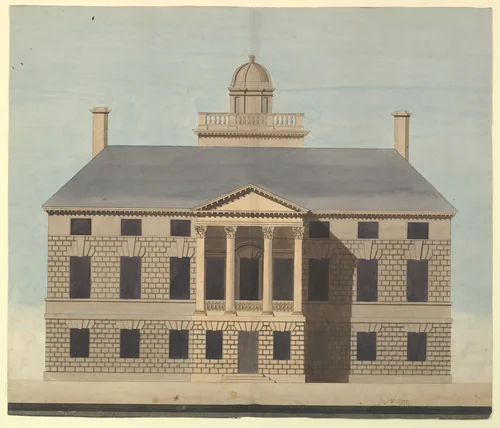
His artistic legacy consists primarily of high-quality documentation drawings, capturing architectural details that might otherwise have been lost to the era’s aggressive urban and institutional renovations. Collections, notably at the Metropolitan Museum of Art, preserve his precise eye, visible in comprehensive visual inventories such as the Album of Architectural Sketches and Drawings. Richardson focused his attention on the interior shell of historic structures, documenting intricate timber and stone detailing. This attention to small, repeatable elements provides invaluable insight into 17th and 18th-century English craft traditions.
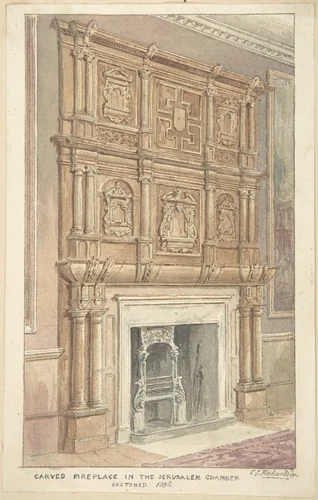
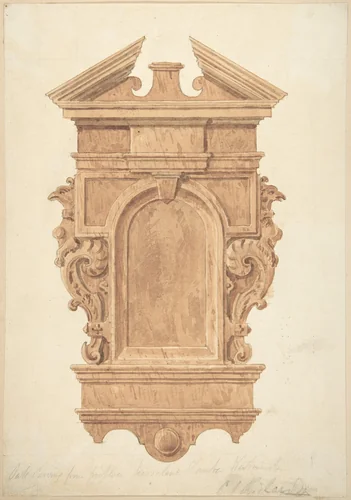
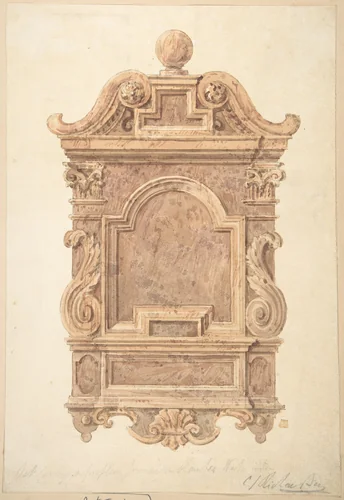
Richardson demonstrated a particular fascination with the medieval remnants preserved within Westminster Abbey. The painstaking documentation of the fireplace in the Jerusalem Chamber appears repeatedly across his known oeuvre, manifested in several studies such as the Design for Oak Carving and detailed renderings of the existing Oak Carving from Fireplace in the Jerusalem Chamber, Westminster. Such dedication to documenting specific timber elements suggests an appreciation that borders on reverence for the skill of earlier craftsmen—a subtle, persistent theme running through his observational work.
Beyond the draughtsman’s table, Richardson was also a noted writer and theorist. His publications solidified his standing within the burgeoning mid-Victorian design culture, emphasizing practical knowledge alongside historical appreciation. This integrated approach, linking historical reference to current design practice, marked him as an authoritative figure whose work informed both construction and conservation. The precision required for these museum-quality renderings ensures their value today, many of which are now in the public domain. Researchers and enthusiasts continue to seek out Charles James Richardson prints, recognizing the historical and aesthetic value inherent in his peerless documentation of historic interiors.
Source: Wikipedia · CC BY-SA 4.0
![Detail of Staircase at [Gerrard?] House, Gerrard Street, Soho, London by Charles James Richardson, drawing, 1825-1871](https://img.artbee.org/fad7741c-9f13-4917-8f60-088a4da56b19/small.webp)