Carlo Urbino
Carlo Urbino (c. 1525/30–1585) was an accomplished Italian painter working during the late High Renaissance and Mannerist periods. Although often studied today through his surviving drawings, Urbino played a significant role in mid-Cinquecento Lombardy, contributing to the rich tradition of narrative religious and historical cycles.
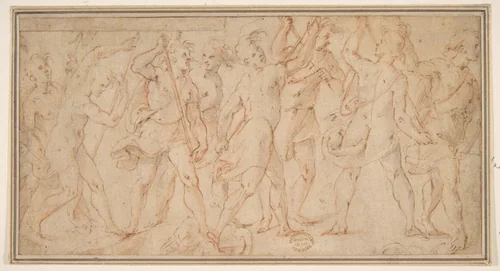
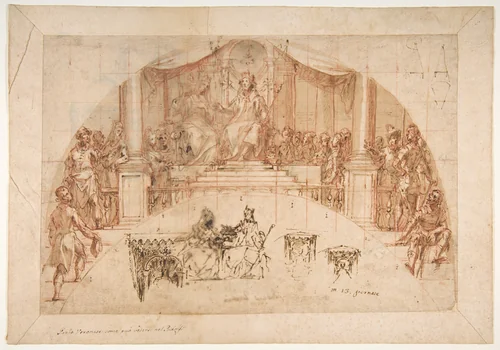
Urbino’s primary artistic legacy rests upon his deft draftsmanship, demonstrated by the five known sheets that define his surviving corpus. These preparatory studies, now cornerstones of American institutional collections including the Metropolitan Museum of Art and the Art Institute of Chicago, reveal an artist deeply concerned with the mechanics of complex figural arrangement. Works such as The Coronation of Esther illustrate his skill in staging dramatic, multi-character scenes, while the detailed study Procession of figures provides a valuable window into his compositional methodology.
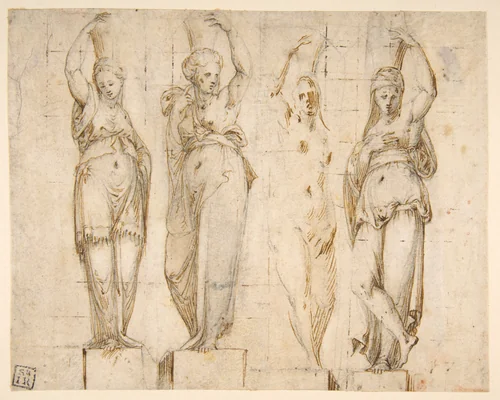
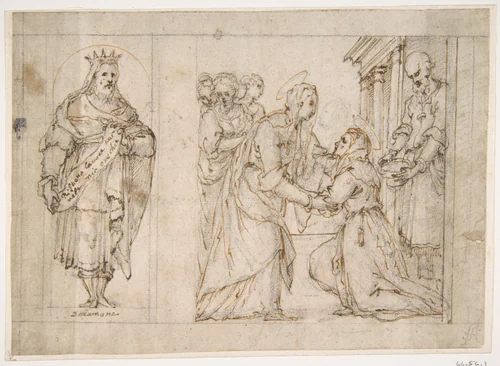
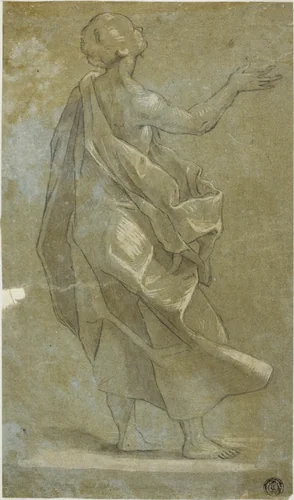
His approach to sacred subjects often integrated precise architectural and historical context. The drawing The Visitation of the Virgin to Saint Elizabeth; King Solomon in a Niche at Left exemplifies this technique, combining devotional narrative with the subtle insertion of classical references. Urbino’s dedication to technical mastery is particularly evident in studies of individual forms, such as the meticulous Standing Draped Male Figure with Raised Right Arm and Four Canephori. In these works, the intense focus on the folds and weight of drapery suggests that Urbino believed clothing itself deserved a significant supporting role in the visual narrative.
These preparatory works underscore the essential role of drawing in Renaissance artistic production, serving as crucial links between conception and finished painting. The migration of these high-quality drawings into museum settings has ensured their preservation and scholarly study. As works that now comfortably reside within the public domain, downloadable artwork and high-quality prints of Carlo Urbino prints are increasingly accessible for academic research and public appreciation, confirming his status as an important, if often understated, contributor to the artistic flowering of 16th-century Italy.
Source: Wikipedia · CC BY-SA 4.0