Carlo Bononi
Carlo Bononi (c. 1569-1615) holds a distinctive position in the history of Italian painting, representing the critical late phase of the famed Ferrarese School. Active during the late sixteenth and early seventeenth centuries, his career bridged the refined complexities of late Mannerism with the dramatic realism characteristic of the emerging Roman Baroque. Though celebrated in his time for grand religious frescos and altarpieces, his enduring artistic legacy rests significantly upon his disegno and the quality of his preparatory work.
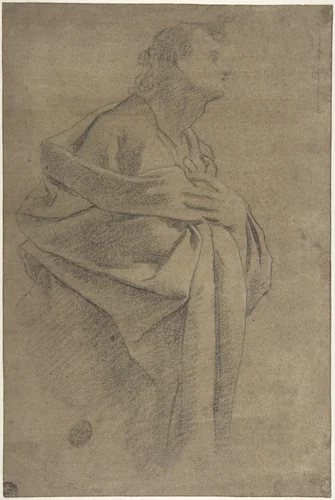
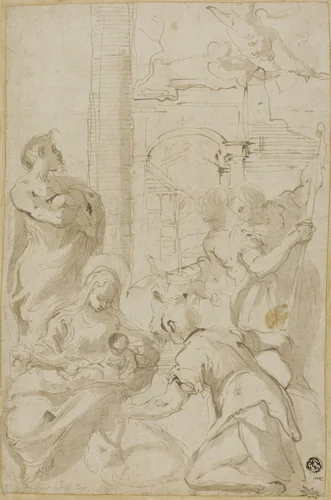
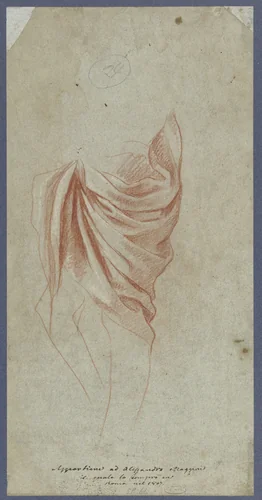
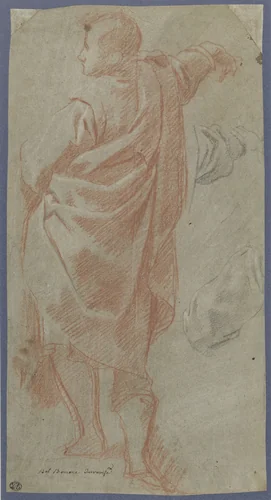
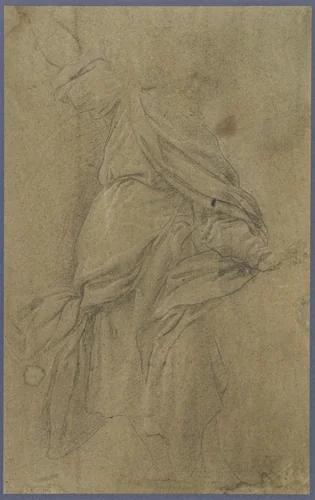
His surviving output, particularly the concentrated body of drawings housed in collections such as the Metropolitan Museum of Art, the Rijksmuseum, and the Art Institute of Chicago, offers intimate views into his sophisticated academic process. Drawings like Studie van een jongeman in een mantel en details and Studie van een draperie op een mannelijk naaktmodel reveal an artist intensely focused on the complexities of light, shadow, and the fall of fabric, essential groundwork for his ambitious figure compositions. These studies demonstrate the meticulous, museum-quality approach Bononi brought to every stage of creation. His detailed, two-sided works, such as Saint Bartholomew (recto); Study of Drapery and Two Hands (verso), provide vital context for understanding the construction and scale of major Carlo Bononi paintings.
Bononi navigated a challenging historical moment following the incorporation of Ferrara into the Papal States in 1598, an event that significantly diminished regional artistic patronage. Yet, he persevered, often receiving commissions that necessitated a fluid, emotional style distinct from the Florentine or Roman mainstream. His importance was recognized well into the subsequent centuries; as one 1876 volume observed, Bononi stood among "the last artists of any eminence in Ferrara." This observation serves less as a critique of his skill than as an acknowledgment that he successfully maintained the prestige of a great artistic tradition just as its regional foundation dissolved. For modern appreciation, high-quality prints of these precise academic drawings are increasingly sought after, confirming the lasting relevance of his mastery of the human form.
Source: Wikipedia · CC BY-SA 4.0